Key takeaways:
- Trump signed an executive order seeking to rename Lake Ontario as Lake America for U.S. government purposes.
- Google Maps now shows “Lake America” to U.S. users, “Lake Ontario” to Canadian users and both names to users elsewhere.
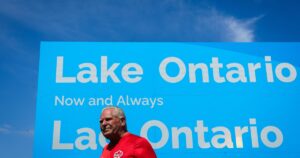
- Ontario Premier Doug Ford unveiled a large sign reading “Lake Ontario. Now and Always” and said the lake’s name would outlast Trump.
Canada pushed back Saturday against President Donald Trump’s move to have the U.S. government call Lake Ontario “Lake America,” installing a towering sign on the Canadian shoreline that reads: “Lake Ontario. Now and Always.”
The sign, erected near Grimsby, Ontario, is the latest public volley in a dispute that began after trade talks collapsed between the United States and Canada. The BBC reported that the U.S. has imposed new 50% tariffs on $20 billion, or C$28 billion, of Canadian goods, and that Canada plans “dollar for dollar” counter-tariffs next month.
Trump signed an executive order Thursday seeking to rename the lake for U.S. government purposes. “We’re going to be changing the name of Lake Ontario effective immediately to Lake America,” Trump told reporters before signing the order, according to The Guardian. The BBC reported that the order gives the U.S. Department of the Interior 30 days to update the name change with the Geographic Names Information System, the official U.S. repository of domestic geographic names.
Ontario Premier Doug Ford said Trump was targeting the lake’s name because he “didn’t like Ontario and Canada standing up for ourselves.” Standing before the new sign, Ford said, “Just in case President Trump or anyone else forgets, we’ve set up this sign to remind them, it’s Lake Ontario, now and forever.”
Ford also said in a social media video: “Long before President Trump, this lake was called Lake Ontario. Long after President Trump is gone, it will still be called Lake Ontario.”
Canadian Prime Minister Mark Carney has rejected the name change, saying Lake Ontario comes from an Indigenous Wendat word meaning “the lake is beautiful, the lake is great” and dates back more than 400 years. Carney has said “things must be called by their name, and this lake is called Lake Ontario — today and forever.”
Wendat Nation Grand Chief Pierre Picard called the U.S. move an attempt to erase Indigenous history. “I want to tell him that it is unacceptable for us, as a nation, to have a president who can eradicate our history, our culture and our identity,” Picard said.
On Saturday, Google said it had changed the lake’s name on Google Maps for users in the United States because the company reflects name changes in official government sources. “People using Maps in the US will see ‘Lake America’, those in Canada will continue to see ‘Lake Ontario’ and those outside of the US and Canada will see both names,” Google said in a blog post quoted by the BBC.
The company said the U.S. Geographic Names Information System “sets the standard for official US maps,” according to The Guardian. Google took a similar approach after Trump directed U.S. agencies to refer to the Gulf of Mexico as the Gulf of America; U.S. Google Maps users currently see that body of water labeled “Gulf of America.” Mexico rejected that renaming, arguing that one country could not rename a shared body of international water, the BBC reported.
Trump amplified the dispute Saturday by posting AI-generated videos on social media. One showed him kicking over a Lake Ontario sign and replacing it with one reading “Welcome to Lake America” while dancing to the Village People song “YMCA.” Another depicted Canada geese with Trump-like blond hair carrying rifles as they patrolled the shoreline of “Lake America.”
Manitoba Premier Wab Kinew dismissed the move as an attempt to revive an earlier political theme. “He’s trying to play the hits for his base,” Kinew said. “But I think everybody here thinks it’s a little sad, and it’s not his best work.”
Lake Ontario borders the Canadian province of Ontario and the U.S. state of New York. It is the smallest of North America’s five Great Lakes by surface area, at 7,340 square miles.





Be First to Comment