Key takeaways:
- Yayoi Kusama died Aug. 14 at a Tokyo hospital at age 97; her representative David Zwirner said the cause was multiple organ failure.
- Kusama was known for repetitive motifs including polka dots, infinity nets, mirrored rooms, pumpkins, lights and psychedelic installations.
- Her work was exhibited at major museums including MoMA, the Whitney, the Hirshhorn and the Tate, and she received Japan’s Order of Culture in 2016.
Yayoi Kusama, the Japanese artist whose polka dots, mirrored rooms and vivid sculptures made her one of the world’s most recognizable contemporary artists, has died. She was 97.
Kusama died Aug. 14 at a hospital in Tokyo, Yayoi Kusama Studio said. Her representative David Zwirner said in a statement that she died of “multiple organ failure.”
“She continued to paint until her final days, never setting aside her brush, and continued exploration of forever love and eternal soul,” the studio said. “We will carry forward Kusama’s wishes and, through art, continue to bring hope and strength for the future to people around the world.”
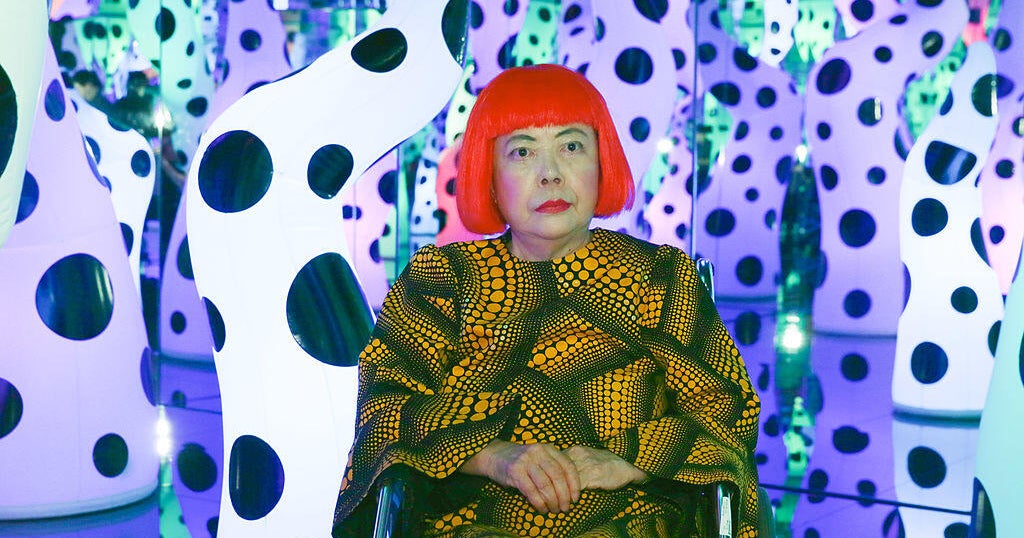
Kusama built a vast body of work around repetition: dots, nets, swirls, mirrored reflections, pumpkins, lights and forms that seemed to stretch beyond the limits of a room or canvas. Her “Infinity Rooms,” enclosed spaces lined with mirrors and often filled with twinkling lights, became among her best-known installations. She also made paintings, sculptures, films and novels.
“Polka dots are fabulous,” Kusama told The Associated Press in 2012, appearing in her signature orange bob wig and polka dot-covered clothing. “I want to create a thousand paintings, maybe two thousand paintings, as many as I can draw. I will keep painting until I die.”
Kusama said her art reflected the way she saw the world, shaped by hallucinations that began in childhood. NPR reported that she wrote in her autobiography that drawing the visions in sketchbooks helped “ease the shock and fear” of the episodes. She often described making art as necessary to her survival. “Our earth is only one polka dot among a million stars in the cosmos,” she wrote.
Born in Matsumoto, in central Japan, Kusama grew up in a family that owned a seed nursery. During World War II, she and other children worked long hours in a parachute factory. Her family, according to CBS News, wanted her to marry and offered kimonos rather than paints and brushes. After finding a book of Georgia O’Keeffe’s paintings in a secondhand store, Kusama wrote to the American artist for advice. O’Keeffe encouraged her to travel to the United States and show her work.
Kusama moved to New York in the late 1950s, becoming one of the first Japanese women to pursue art there. She entered a male-dominated avant-garde scene where “action painting” was in vogue, but she continued with her dotted and netted imagery through years of poverty and obscurity. She befriended artists including Andy Warhol, O’Keeffe and Joseph Cornell.
In the late 1960s, she staged anti-war “happenings,” placing paper circles or painting dots on people’s bodies, and once on a horse. NPR reported that during the Vietnam War, she painted polka dots on naked protesters and distributed an open letter to President Richard Nixon. “You can’t eradicate violence by using more violence,” she wrote.
“She shocked the living daylights out of people,” Richard Castellane, her dealer in the 1960s, told NPR in 2017. He said visitors to one mirrored installation with blinking lights “had no sense of space because space was infinite.”
Kusama returned to Japan in the early 1970s and checked herself into a psychiatric institution, where NPR reported she lived for the rest of her life. She continued making art in a studio across the street.
Her popularity surged later in life. Her work was shown at institutions including the Museum of Modern Art, the Whitney Museum of American Art, the Smithsonian’s Hirshhorn and the Tate in London. The Yayoi Kusama Museum opened in Tokyo in 2017. She also collaborated with brands including Louis Vuitton, and her designs appeared on products such as cellphone cases, cosmetics, teacups, T-shirts and key chains.
In 2008, Christie’s auctioned one of her works for $5.8 million. In 2016, she received Japan’s Order of Culture. “I feel there is little left in my life, but I am now still fighting to the death for my art,” she said at the time. “I am giving all I have so that many people will continue to be interested in my art, even after I am dead.”







Be First to Comment