Key takeaways:
- Jenny Simpson collapsed during a mile event in Raleigh, North Carolina, in June and was revived with CPR and an automated external defibrillator before being hospitalized.
- Doctors diagnosed Simpson with arrhythmogenic right ventricular cardiomyopathy, a rare congenital heart condition that caused dangerous rhythms and cardiac arrest.
- Simpson won Olympic bronze in the 1,500 meters in 2016, was the 2011 world champion and says returning to running would be dangerous.
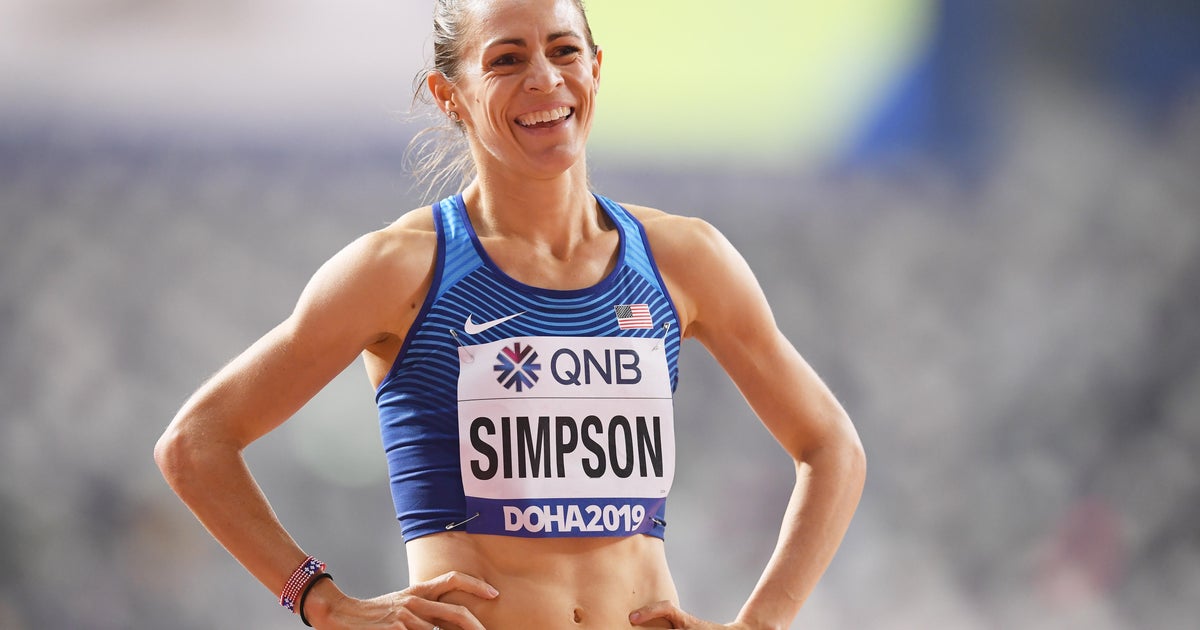
Three-time Olympian Jenny Simpson says she will not run again after a sudden cardiac arrest in June revealed a rare congenital heart condition and nearly killed her during a track event in North Carolina.
Simpson, 39, collapsed moments after helping a group of girls pace themselves through a milelong run in Raleigh. She told CBS News she does not remember what happened that day. But Ivy and Joey Pointer, friends and co-workers through the running company Fleet Feet, saw the emergency unfold and helped save her life.
Joey Pointer is the CEO of Fleet Feet, which hired Simpson earlier this year as chief running officer. Ivy Pointer is a pediatric intensive care unit physician. Because their child has congenital heart disease, the couple carries an automated external defibrillator.
“When I looked over from afar, I knew that something was very, very wrong,” Ivy Pointer told CBS News. “So I told Joey to grab an AED and ran over and got there…. I just remember thinking like, ‘This can’t happen right now. Like we have a lot happening soon and that this is not going to happen right now. You are going to fight. You’re going to hold on. You have to wake up.’ And I just kept saying her name and kind of screaming her name, honestly.”
Ivy Pointer and other bystanders performed CPR until first responders arrived. Simpson was taken to a hospital, suffered a second cardiac arrest and was then transferred to Duke University Medical Center, CBS News reported. Her husband, Jason, flew to be with her as she spent days on life support because of problems involving her heart and lungs.
“I’ve spent so much of my life and my career bringing people joy, and to wake up and see that the room was full of heaviness and sorrow — that was really hard,” Simpson told CBS News.
In an Instagram post Thursday, Simpson said doctors diagnosed her with arrhythmogenic right ventricular cardiomyopathy, or ARVC. She described it as a condition that triggered “dangerous heart rhythms that ultimately caused my heart to stop.” CBS News described it as a rare congenital heart condition in which the heart repairs damage with tissue that does not properly conduct electricity in the right ventricle.
Running did not cause the condition, Simpson said, but it eventually revealed it. The diagnosis means returning to running would be dangerous.
“That chapter has ended,” she wrote. “Thankfully, my story hasn’t.”
Simpson has had a defibrillator and pacemaker implanted and is recovering at home. She said she will continue working at Fleet Feet, where she remains connected to the sport that shaped her life.
“You might be wondering what would be the right thing to say to me after an event like this,” she wrote on Instagram. “Please do not say that you’re sorry or that you feel bad for me. If it is true in your heart, please tell me you’re glad that I’m here. That’s how I feel – so glad that I’m still here.”
Simpson represented the United States at the Olympics in Beijing, London and Rio de Janeiro. She won bronze in the 1,500 meters at the 2016 Rio Games, becoming the first American woman to medal in the event. She also won the 2011 world title in the 1,500 meters, took silver at the 2013 and 2017 world championships and claimed 11 U.S. titles before retiring from elite running in 2024.
Before the cardiac event, Simpson had spent the past year on a 50-state running tour with her husband, joining local groups in scenic and far-flung places. She said the circumstances of her collapse — near people trained and equipped to respond — felt profound.
“It means to me that there was a God present in all of this,” Simpson told CBS News. “My family doesn’t have a history of heart conditions. I don’t know that a lot of the time in my life I’m around people that know how to intervene when there is a heart condition. And it’s like I got plucked out of my home and put into this family.”
Simpson said she is still learning what recovery will look like. For now, she is focused on gratitude and on how she spent what became her final mile.
“To think that the way I showed up as a person and as a woman with my last mile was in community, taking young girls around the track, I’m really proud of that,” she said. “That’s what I’m grateful for. That’s what I want to remember.”





Be First to Comment