
Key takeaways:
- Pope Leo XIV calls for the 'disarming' of AI to prevent it from dominating humanity and fueling conflict.
- The encyclical warns AI risks making civilization 'less human' by hollowing out work and concentrating wealth.
- The pope urges stronger regulation, slower AI adoption, and rigorous ethical constraints on autonomous weapons.
Pope Leo XIV released a landmark encyclical Monday addressing the profound challenges posed by artificial intelligence, calling for the “disarming” of AI to prevent it from dominating humanity and fueling global conflict. The 82-page document, titled Magnifica Humanitas (Magnificent Humanity), warns that AI risks making civilization “less human” by hollowing out work, concentrating wealth, and reducing people to data-driven systems devoid of dignity and morality.
The first U.S.-born pope invoked his namesake, Pope Leo XIII, who guided the Church through the Industrial Revolution, to frame the current AI revolution as an “anthropological” crisis affecting the meaning and purpose of humanity. “The pressing duty,” Leo wrote, “is to remain profoundly human.”
Leo emphasized that technology itself is not inherently evil, calling AI “a great human achievement,” but stressed the need for responsibility. He warned against the concentration of AI power in the hands of a few private interests and governments, which could lead to a race for ever more powerful algorithms and larger datasets aimed at geopolitical or commercial dominance.
“Merely regulating it is insufficient,” the pope wrote, advocating for stronger oversight and a slower pace of AI adoption as an exercise of “responsible care for the human family.” He cautioned that AI-driven autonomous weapons systems make war more feasible and less subject to human control, urging that their use be subject to the “most rigorous ethical constraints” to protect human dignity and avoid escalating violence.
The encyclical also addresses broader societal concerns, including AI’s potential to hollow out the middle class, deepen inequality, fuel social fragmentation, and normalize AI-driven warfare. “There exists no algorithm capable of making war morally acceptable,” it states.
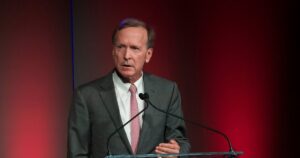
The Vatican’s presentation included Christopher Olah, co-founder of the AI company Anthropic, which has refused unrestricted U.S. military access to its technology and was recently listed as a supply-chain risk by the Trump administration. Olah acknowledged that AI labs operate within incentives that can conflict with ethical considerations and welcomed input from outside groups, including the Catholic Church, to guide AI development responsibly.
Cardinal Michael Czerny, who helped present the document, said the encyclical is “not about AI” but about “the human condition during the time of AI.” He noted concerns that people might begin treating AI as a substitute for God, calling such tendencies “idols.”
In addition to AI, Pope Leo issued a first-ever apology for the Vatican’s role in facilitating and justifying the transatlantic slave trade, calling it “a wound in Christian memory” and asking for pardon in the name of the Church.
The encyclical was signed May 15 to coincide with the 135th anniversary of Pope Leo XIII’s Rerum Novarum, which addressed workers’ rights during the Industrial Revolution. The current pope, a mathematics graduate, seeks to provide a moral compass and ethical framework for navigating the AI revolution, emphasizing that technology should serve humanity rather than dominate it.









Be First to Comment