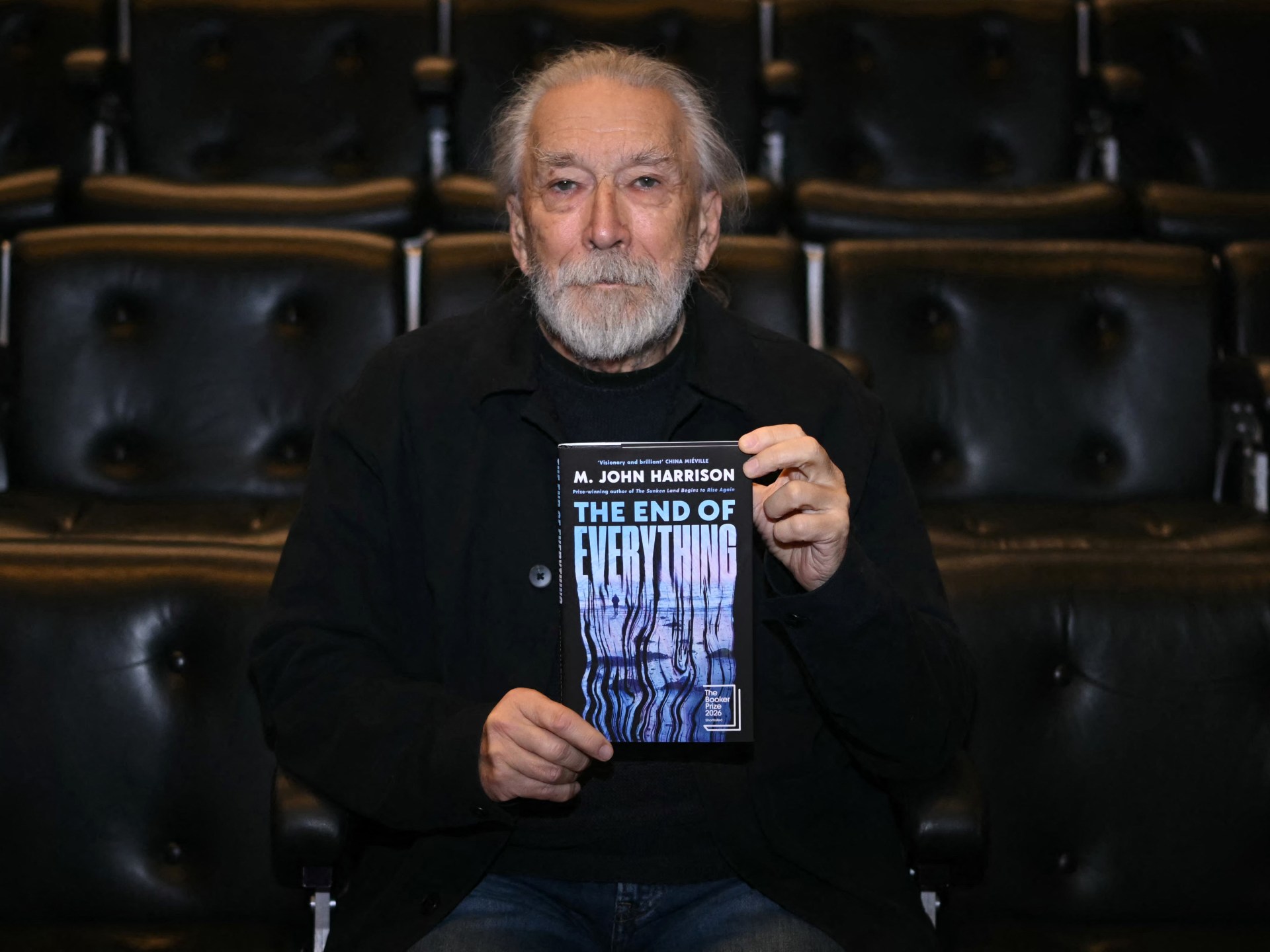
Key takeaways:
- Harrison won the £50,000 Booker Prize after the judges reached a unanimous decision.
- The End of Everything follows a man and his aunt on England’s southeast coast after a catastrophe and the arrival of mysterious alien beings.
- At 81, Harrison surpassed Margaret Atwood as the oldest Booker Prize winner.
M John Harrison has won the Booker Prize for The End of Everything, a post-apocalyptic novel that leaves its characters — and readers — struggling to understand a shattered world. At 81, the British author is the oldest winner in the award’s history.
Harrison received the £50,000 prize at a ceremony in London on Monday after the judges reached a unanimous decision. He surpassed Margaret Atwood, who was 79 when she won in 2019, according to Al Jazeera.
The End of Everything is set on England’s southeast coast after an unexplained catastrophe has upended society and mysterious alien beings have arrived. A man living with his aunt tries to get by amid the upheaval. Al Jazeera reported that the 198-page novel centres on a beachcomber, his gun-toting aunt and a shape-shifting artefact he finds on the shore.
Harrison has said he deliberately withheld explanations so readers would share the characters’ confusion. “The End of Everything is about trying to live as if nothing has gone wrong,” he said, according to the BBC. “It’s a disaster story in which the disaster is the failure to comprehend.”
Speaking to BBC Radio 4 on Tuesday, Harrison said he wanted to satirise the flood of information people encounter without necessarily having the tools to analyse it. The book, he said, grew from the idea of “a disaster of explanation, a disaster of the failure to understand the world as it was now.”
Dame Mary Beard, who chaired the judging panel, acknowledged the demands the novel places on readers. “It’s a challenging read, but some of the best fiction is challenging,” she said. She described it as a book that “turns you upside down, raises a wry smile” and, despite its subject, leaves “a twinge of optimism.”
Al Jazeera reported that the judges said the book could be read as a “thriller, a mystery, a satire, a dystopia, a road novel, a work of realism”. Beard told the outlet that its characters face a catastrophe they cannot fully explain. “There are bits where you, the reader, are with the characters in not fully understanding,” she said. “Now, I think that’s fantastically exciting.”
The novel has also divided critics. The BBC reported that The Guardian praised it while cautioning that “it won’t be for everyone”; the Literary Review called it “a work of uncanny beauty, tender and terrifying in equal parts.”
Harrison began writing in the 1960s and has published 13 novels, five short-story collections and an “anti-memoir,” according to the BBC. Although he resists labels such as science fiction and fantasy, Booker Prize chief executive Gaby Wood called him “the first Booker winner to have emerged from the bona fide SF world.” Al Jazeera described the novel as the first work of science fiction to win the prize.
The other shortlisted authors were Marlon James, Luke Kennard, Rebecca Perry, Elizabeth Strout and Douglas Stuart. The Booker Prize, founded in 1969, honours a novel written in English.




Be First to Comment