Key takeaways:
- Hall and Woodford were honored for microeconomic foundations of macroeconomic stabilization.
- Their research helped build models used by central banks and governments to respond to economic shocks.
- This year’s prize carries 12 million Swedish kronor, about $1.2 million.
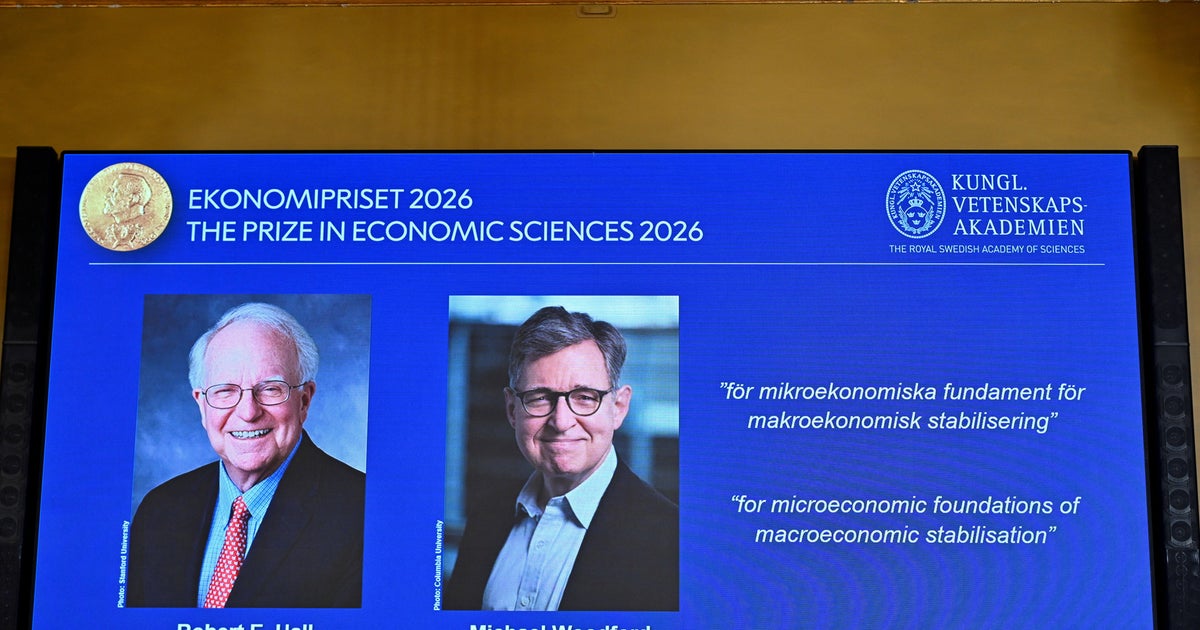
Robert E. Hall and Michael Woodford won the 2026 Nobel memorial prize in economics Monday for research that helps governments and central banks respond to economic shocks and curb damaging swings in inflation and unemployment.
The Royal Swedish Academy of Sciences honored the two American economists “for microeconomic foundations of macroeconomic stabilisation.” Their work helped build models of the broader economy around decisions made by individual households and businesses, rather than relying only on statistical relationships among measures such as inflation, production and consumption.
“The laureates’ work has provided us with a stable theoretical foundation for the models that are now used by central banks and governments around the world,” said John Hassler, chair of the Committee for the Prize in Economic Sciences. “With them, we are better equipped to deal with shocks in the economy, such as energy crises or sudden changes in how much households consume.”
Hall, 83, is affiliated with Stanford University in California. Woodford, who was born in 1955, is affiliated with Columbia University in New York. Reached by phone in New York after the announcement, Woodford said, “It’s a tremendous honor, it’s a surprise.”
Their research addressed a problem that became stark in the 1970s. After the Great Depression, policymakers had drawn on the ideas of British economist John Maynard Keynes, using government spending and tax changes to encourage demand during downturns. But high inflation and high unemployment arrived together during the 1970s, challenging assumptions about how those forces moved in relation to each other.
“This is the Keynesian recipe and it worked well — until it didn’t,” prize committee member Timo Boppart said. The oil crises of that decade exposed shortcomings in the models policymakers had used to decide when and how to intervene.
Hall and Woodford made separate contributions to a new foundation for stabilization policy. NPR reported that Hall studied demand, including how households’ expectations about future income affect what they buy today. Woodford examined how businesses set prices, taking into account what they expect costs to be over time. Their work became part of the “New Keynesian” approach to economics, NPR reported.
Those expectations also matter when officials act. “Government authorities shouldn’t view stabilization of the economy as an exercise that is simply conducted by people pulling levers to control the economy, independent of what people in the economy understand,” Woodford told reporters. He urged policymakers to explain “why the things that are being done are being done.”
The award is formally the Sveriges Riksbank Prize in Economic Sciences in Memory of Alfred Nobel. Sweden’s central bank established it in 1968, and it was first awarded in 1969. Unlike the five prizes created under Nobel’s will, it is a memorial prize, though it is presented with the others on Dec. 10. This year’s prize money is 12 million Swedish kronor, about $1.2 million.
Last year’s economics prize went to Joel Mokyr, Philippe Aghion and Peter Howitt for research on how innovation and new production methods drive growth. Three women have won the economics prize; the most recent was Claudia Goldin in 2023 for work on gender, pay and employment in the United States.






Be First to Comment