Key takeaways:
- Trump and Xi last met in late October in Busan, South Korea.
- The temporary US-China trade truce is set to expire in November.
- Al Jazeera reported average US tariffs on Chinese goods of 36.5%, compared with average Chinese tariffs on US goods of 31%.
President Donald Trump and Chinese President Xi Jinping are meeting in the United States with their trade truce nearing a November deadline. Disputes over artificial intelligence and Taiwan remain unresolved, and experts expect the visit to focus more on steadying relations than on a sweeping agreement.
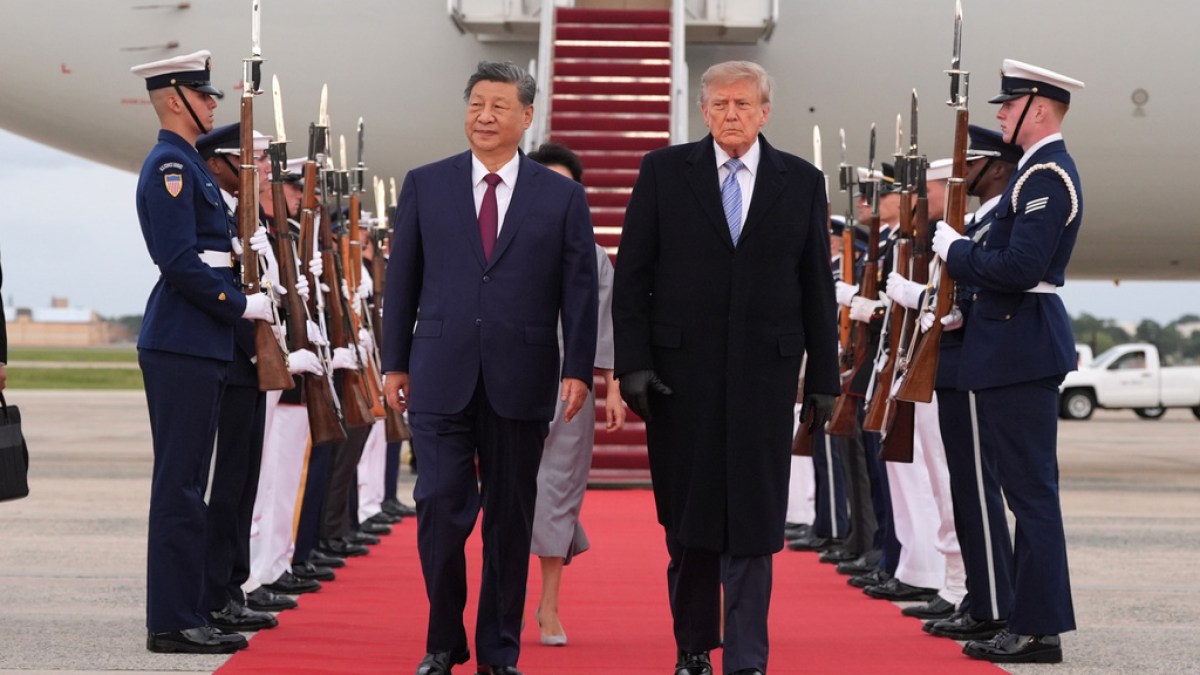
Trump gave Xi a personal welcome at the airport ahead of a state banquet and military flyover, Al Jazeera reported. It is Xi’s first state visit to the United States in more than a decade, according to The Guardian. The leaders last met in late October in Busan, South Korea, where they stepped back from a sharp escalation in their trade dispute.
“This is not a bargaining summit,” Reza Hasmath, an academic faculty adviser at the University of Alberta’s China Institute, told Al Jazeera. “It’s a stabilising summit.”
Trade remains the central issue. Last year, China responded to Trump’s new tariffs with levies on US goods approaching 150% and restrictions on exports of rare earths used in manufacturing, The Guardian reported. Al Jazeera put current average US tariffs on Chinese goods at 36.5% and China’s average tariffs on US goods at 31%.
China resumed supplies of critical minerals after the Busan meeting, but Washington wants deliveries to accelerate, according to Al Jazeera. Mary E Lovely, a senior fellow at the Peterson Institute for International Economics, said the summit’s purpose was “to set up a continuation of the truce.” She said the leaders might announce a mechanism to reduce tariffs on $30bn worth of goods on each side. The Guardian reported that the truce expires in November and that the leaders are expected to meet twice more this year, making an immediate trade deal less likely.
Artificial intelligence is another possible area for discussion. US Treasury Secretary Scott Bessent has proposed a way for the countries to communicate about major AI safety incidents. Amanda Hsiao, the Eurasia Group’s China director, questioned whether such a channel would work, noting that previous US-China crisis hotlines “haven’t always been effective.” Al Jazeera reported that US restrictions on advanced chip sales to China and competition over AI add to the distrust.
Taiwan may prove harder to navigate. China claims the self-governing island as its territory, while Taiwan rejects unification. Chinese Ambassador Xie Feng placed Taiwan first among four “red lines” he outlined before the summit, The Guardian reported. Trump delayed a $14bn US arms-sale package for Taiwan after the leaders’ May meeting in Beijing, calling it a “very good negotiating chip.” Beijing says Taiwan is a domestic matter, not a bargaining issue.
The leaders may also discuss Iran, according to Al Jazeera. The Guardian reported that Trump could raise individual cases, including that of British pro-democracy activist Jimmy Lai, who was jailed in Hong Kong. Climate cooperation is unlikely to receive meaningful attention, The Guardian reported.
“There’s a whole lot at stake given the huge trade relationship, including for the rest of the world,” Dexter Tiff Roberts, a senior fellow at the Atlantic Council’s Global China Hub, told Al Jazeera.




Be First to Comment