Key takeaways:
- Abelardo de la Espriella took office Friday in Cali, where about 11,000 troops were deployed and drones and private vehicles were banned for inauguration day.
- The new president has pledged to end peace talks with rebel groups, use greater military force and cut government spending by as much as 40%.
- Petro alleged vote manipulation after the election, but Al Jazeera reported that international observers and Colombian electoral authorities dismissed the claim and that Petro ultimately said he would respect the outcome.
Abelardo de la Espriella was sworn in Friday as Colombia’s president in a heavily guarded ceremony in Cali, promising a sharp turn toward military pressure on armed groups and deep cuts in government spending after four years of leftist rule under Gustavo Petro.
The 48-year-old conservative lawyer, a political newcomer praised by President Donald Trump, broke with tradition by taking the oath outside Bogotá. He chose Cali, a southwestern city hit hard by drug violence and attacks by armed groups, for an inauguration that placed security at the center of his first day in office.
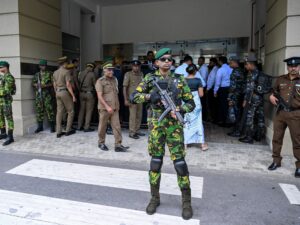
About 11,000 troops were deployed in the city, NPR reported. Soldiers and armored vehicles lined roads near the venue, while police screened vehicles for explosives in the days before the ceremony, according to Al Jazeera. Drones were banned, and privately owned vehicles were kept off city roads during inauguration day.
“One of the fundamental priorities of my government will be to exert control of our territory,” de la Espriella said in a speech earlier this week. “If we don’t control our cities and our rural areas, this nation will lose its sovereignty.”
After the ceremony, de la Espriella traveled to a nearby military battalion to address troops, a move Al Jazeera said was intended both to boost morale in the armed forces and signal his approach to Colombia’s armed groups.
De la Espriella has said he will end peace talks with rebel groups and confront them with greater military force. He has also backed tougher anti-crime measures, including building large prisons and using aerial spraying and drones to destroy illegal coca crops, a practice Colombia halted more than a decade ago because of environmental concerns.
Petro had pursued negotiations with armed groups under a policy known as “Total Peace.” Critics say the strategy failed, arguing that some groups used ceasefires to rearm, regroup and expand control in rural communities. Armed groups and drug gangs have grown stronger in rural areas over the past four years, profiting from illegal mining, extortion and the drug trade.
Colombia’s southwest remains contested by dissident factions of the demobilized FARC rebel movement that rejected a peace deal signed a decade ago, as well as the Clan del Golfo drug cartel and the National Liberation Army, or ELN, Al Jazeera reported.
Elizabeth Dickinson, a Colombia analyst at the International Crisis Group, said de la Espriella’s victory shows that “the pendulum swings back to the right” after Petro’s administration struggled to produce results in talks with armed groups. She said more military pressure could weaken rebel organizations and prompt some fighters to demobilize, but warned against closing off talks entirely.
“We’re talking about a conflict that has an estimated 27,000 individuals involved in different armed and criminal groups,” Dickinson said. “These individuals will need a route back into normal life.”
NPR reported that de la Espriella won the presidential election by about 250,000 votes, defeating left-wing candidate Iván Cepeda by roughly one percentage point. Al Jazeera described the vote as a June runoff in which he defeated Petro. Petro initially refused to accept the result, alleging vote manipulation; Al Jazeera reported that the claim was dismissed by international observers and Colombian electoral authorities and that Petro ultimately said he would respect the outcome.
Protests broke out Friday in Cali, Bogotá and Barranquilla, Al Jazeera reported. In Cali’s Puerto Resistencia neighborhood, protester Sebastian Ocampo, 25, said residents were “defending dignity” against a president he said had not won their support.
Foreign guests included Spain’s King Felipe VI, acting U.S. Attorney General Todd Blanche, FIFA President Gianni Infantino, Argentina’s Javier Milei and Chile’s José Antonio Kast. NPR also listed Ecuador’s Daniel Noboa among those expected to attend.
De la Espriella has pledged to cut government spending by as much as 40% and has announced plans to close 14 Colombian embassies in Europe, Africa and the Caribbean. Al Jazeera reported that he has also promised to revive Colombia’s oil and gas industry.
On foreign policy, he has moved closer to Washington, backed U.S. strikes on suspected drug vessels in the Caribbean and eastern Pacific, and is expected to accelerate extraditions of rebel leaders wanted in the United States on drug charges. He has also pledged to restore relations with Israel and cut ties with Cuba; Al Jazeera reported he also vowed to sever ties with Nicaragua.


Be First to Comment