Key takeaways:
- Authorities said the Gironde wildfire near Bordeaux was broadly stable after burning an area four times the size of Paris.
- Spain evacuated about 76,000 people and confined 30,000 others to their homes as fires burned around Madrid and Valencia.
- France’s national firefighters federation said the blazes produced a pyrocumulonimbus, a fire cloud phenomenon it said had never before been seen in the country.
French President Emmanuel Macron called a crisis meeting Monday as firefighters battled massive wildfires in southwest France and Spain ahead of a forecast heat wave that could make the blazes harder to contain.
The largest French fire, burning in the Gironde region near Bordeaux, has scorched an area four times the size of Paris and forced widespread evacuations. Authorities said overnight conditions were “globally stable” or “broadly stable,” offering the first sign that the spread of the blaze may have slowed after days of advancing toward the wine-region city.
Still, officials warned the danger was far from over. Bordeaux Mayor Thomas Cazenave said Sunday that the fire “is still at the gates of the metropolitan area.” At its closest point, Al Jazeera reported, the flames were 15 kilometers, or 9 miles, from metropolitan Bordeaux, home to about 850,000 people.
“This is a fire of a size never seen before,” said Jerome Steffe, the mayor of Cestas, a suburb outside Bordeaux.
Macron’s meeting was aimed at coordinating the response as crews fought the fires on the ground and from the air, using water- and retardant-dropping aircraft. The effort has become a race against time, with temperatures expected to rise from Tuesday and another heat wave forecast later in the week.
In the neighboring Landes region, authorities said firefighters had made progress against a smaller but intense blaze. Some rain fell overnight, and the prefecture described conditions as “favorable” for firefighting, while cautioning that they could change.
No new evacuations were announced in Gironde, but officials moved to keep tourists away as France approaches its peak August travel season, banning holiday camps for children and for people with disabilities.
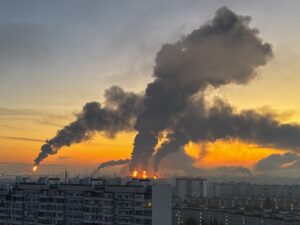
The fires have produced a pyrocumulonimbus — a giant fire cloud that can generate its own winds and carry lightning, and sometimes tornadoes, that may spark new blazes, according to France’s national firefighters federation. The federation said the phenomenon had never before been seen in the country, AFP reported.
“It’s a David-versus-Goliath scenario…. At some point, we’ll find a weak spot and strike there,” federation spokesman Eric Brocardi said, according to AFP.
Macron pledged support for affected communities in a weekend post on X. “We will rebuild, we will repair and we will be present for as long as necessary,” he said.
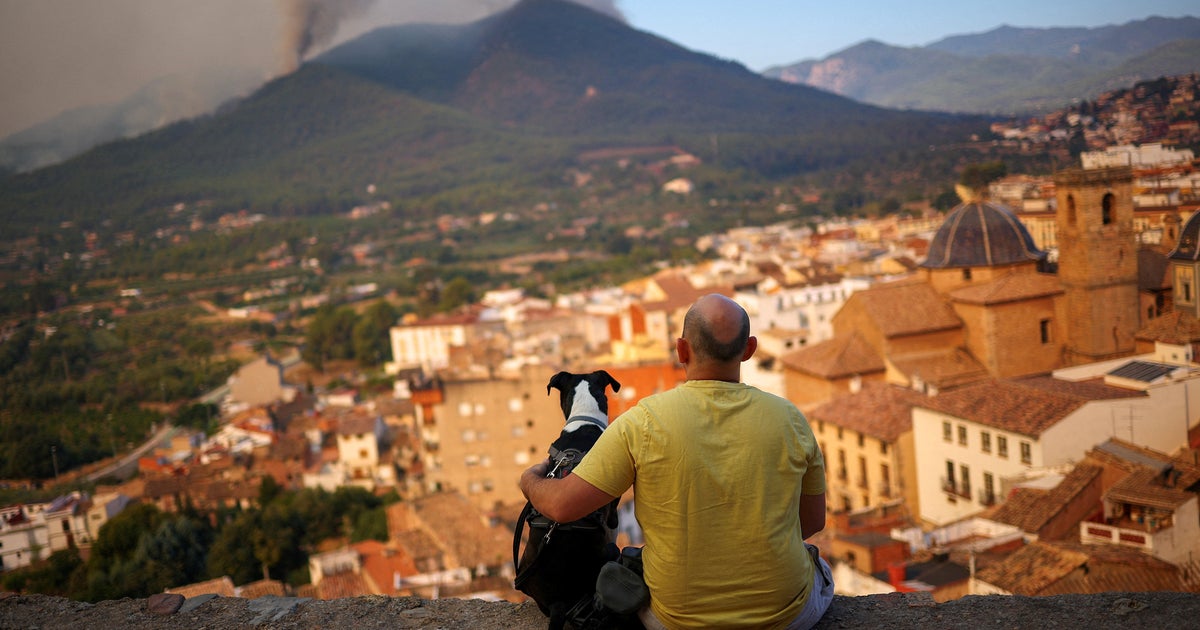
The crisis extends beyond France. In Spain, wildfires have burned out of control around Madrid and in the Valencia region. Authorities evacuated about 76,000 people and confined 30,000 others to their homes, according to CBS News. Al Jazeera reported that more than 75,000 people had been evacuated in Spain and that, across France and Spain, more than 300,000 people had fled their homes.
Some of the worst Spanish blazes were moving closer to Madrid but had “slowed their advance,” the regional government said Monday. Authorities said they would begin allowing some evacuees from Madrid to return home.
For many, the uncertainty remained severe. “It looked like the apocalypse,” said Rocío Domínguez, who fled Chapinería, west of Madrid, with her dog, Simba. “You couldn’t see anything. Everything was covered in ash.”
“We don’t know when we get to the town, if we’ll have half the house burned down or we’ll have it intact or we won’t have a house,” she said. “All the clothes, all the memories, everything.”
The fires have erupted during a summer of extreme heat in Europe. Al Jazeera reported that the continent has already experienced three heat waves this summer and that several countries have set new temperature records. In France and Spain, the scale of the blazes has intensified calls for action on climate change.
“What we are experiencing is not a series of isolated incidents,” Spanish Prime Minister Pedro Sánchez said. “It is the consequence of a climate emergency that is making wildfires even more violent, heat waves more frequent.”






Be First to Comment