Key takeaways:
- The amendment failed 104-314, with 103 Democrats voting yes, 98 voting no and 10 voting present.
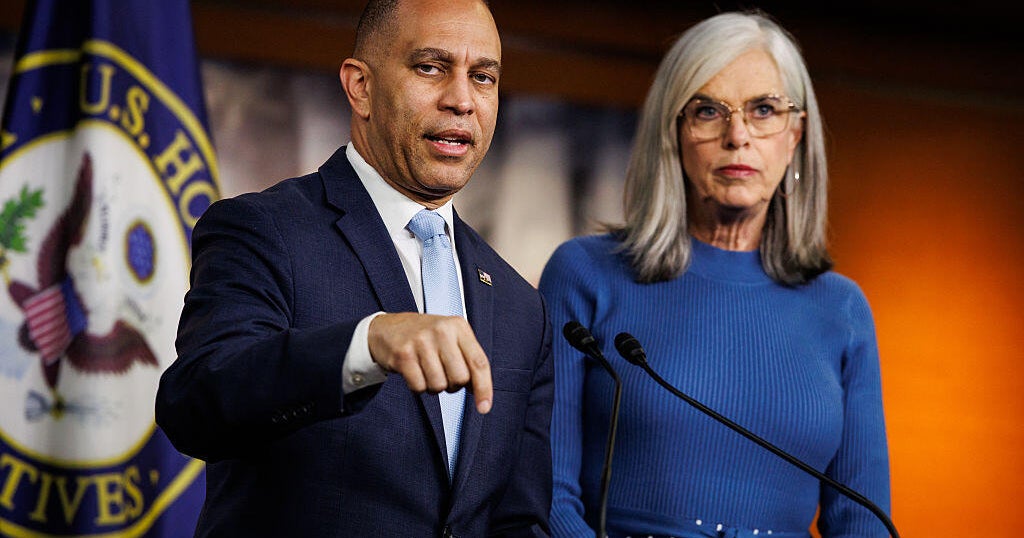
- House Minority Leader Hakeem Jeffries opposed the measure, while House Minority Whip Katherine Clark voted for it.
- The proposal from Rep. Thomas Massie would have blocked $3.3 billion in U.S. security assistance for Israel.
House Democrats split sharply Wednesday over a proposal to cut off U.S. aid to Israel, exposing a widening rift inside the party over Washington’s support for a longtime ally amid the war in Gaza and broader conflict in the region.
The amendment, offered by Rep. Thomas Massie, R-Ky., to the annual State Department and national security appropriations bill, failed 104-314, with 10 lawmakers voting present. Massie, a vocal non-interventionist and fiscal conservative who has consistently opposed foreign aid, sought to bar funding in the bill from being used for Israel and to block $3.3 billion in U.S. security assistance.
The vote divided House Democrats nearly down the middle. A total of 103 Democrats joined Massie in voting yes, while 98 Democrats joined 215 Republicans in voting no. Ten Democrats voted present.
The split reached the top ranks of Democratic leadership. House Minority Leader Hakeem Jeffries of New York opposed the amendment, calling it “overly broad.” House Minority Whip Katherine Clark of Massachusetts, the party’s No. 2 leader in the chamber, broke with him and voted for it.
In a letter to colleagues Tuesday, Jeffries said the measure “would restrict our country’s ability to confront Hamas, Hezbollah and other terrorist organizations in the region who are sworn enemies of both the United States and Israel.” CBS News reported that Jeffries also said the amendment could limit funding for longstanding initiatives tied to humanitarian aid, refugee resettlement, peace-building and U.S. Embassy operations. He called for a “major reset” between the United States and Israel but said party leaders would not pressure members to vote a certain way.
Clark said before the vote that “the status quo is not tenable.”
“We should not provide a blank check for military aid to any country that does not comply with U.S. law, interests, and values,” she said. “The Netanyahu government has failed to meet that standard. I will be voting yes, not because I agree with the entirety of the amendment, or the GOP’s cynical motivations for its consideration, but because I believe we must change course.”
Clark added that Democrats were “absolutely united in our shared goal of permanent peace,” even as members made different decisions on the amendment.
Other senior Democrats also split. House Democratic Caucus Chairman Pete Aguilar and Vice Caucus Chairman Ted Lieu, both of California, voted no. Speaker Emerita Nancy Pelosi of California and Assistant Minority Leader Joe Neguse of Colorado voted yes.
Rep. Ami Bera of California, who serves on the Foreign Affairs and Intelligence committees, said he would vote present because he supports the U.S.-Israel relationship but does not “condone the Netanyahu government’s conduct of the war in Gaza and the resulting humanitarian crisis, its actions in Lebanon, its failure to confront escalating settler violence in the West Bank, and its role in drawing the United States into the current war with Iran.”
The vote came as Democratic leaders face pressure from progressives to take a harder line against Israel. Rep. Greg Casar of Texas, chairman of the Congressional Progressive Caucus, circulated a letter urging support for the amendment and wrote that “The Democratic Party needs a new approach to Israel and Palestine.”
“The American people are crying out for an end to US tax dollars subsidizing Israel’s military,” Casar wrote, adding that U.S. funds are going to a military he said has killed tens of thousands of civilians in Gaza, the West Bank and Lebanon. Casar said he wished the amendment were more narrowly tailored to military funding but that “opposing the billions in military funding is what’s most important here,” according to CBS News.
The debate follows signs of shifting public opinion. According to a Gallup tracking poll cited by NBC News, Americans in February said for the first time that they were more sympathetic to Palestinians, at 41%, than Israelis, at 36%. Among Democrats, 65% said they were more sympathetic to Palestinians, while 17% said they were more sympathetic to Israelis.










Be First to Comment