Key takeaways:
- Khamenei’s coffin lay in state Friday at Tehran’s Grand Mosalla, with public mourning and processions scheduled to begin Saturday.
- Iranian officials expect millions of mourners, with ceremonies planned in Tehran, Qom, Najaf, Karbala and Mashhad.
- Gen. Ahmad Vahidi, head of the Revolutionary Guard, appeared publicly for the first time in months during the funeral events.
Iran opened days of funeral ceremonies Friday for Supreme Leader Ayatollah Ali Khamenei, displaying his flag-draped coffin in Tehran as officials sought to draw vast crowds after a war that killed the 86-year-old cleric and members of his family.
Khamenei’s body lay in state at the Grand Mosalla religious complex, where black-clad mourners, senior Iranian officials and foreign dignitaries paid their respects. Iranian authorities expect millions to fill the streets of Tehran beginning Saturday, with processions planned through cities in Iran and neighboring Iraq before burial next week.
The late leader’s coffin was displayed alongside caskets for relatives killed in the Feb. 28 strike at the start of the war. NPR reported the attack was an Israeli airstrike and identified the dead as Khamenei’s son-in-law, eldest daughter, 14-month-old granddaughter and the wife of Iran’s new supreme leader, Ayatollah Mojtaba Khamenei. Al Jazeera described the strike as a joint U.S.-Israeli attack and said the relatives included Khamenei’s three-year-old granddaughter, eldest daughter, son-in-law and daughter-in-law.
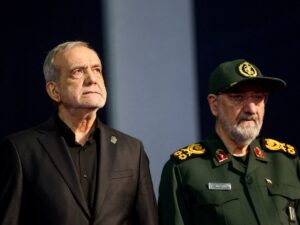
Iranian President Masoud Pezeshkian, Parliament Speaker Mohammad Bagher Qalibaf and Foreign Minister Abbas Araghchi were among those shown paying their respects. Al Jazeera reported that more than 50 delegations had already attended, including the presidents of Iraq, Tajikistan, Turkmenistan and Georgia, as well as Pakistan’s Prime Minister Shehbaz Sharif. Its correspondent said Iran had not invited several European countries, and that attendees were “mostly from either neutral or friendly states.”
Gen. Ahmad Vahidi, the head of Iran’s paramilitary Revolutionary Guard, also appeared publicly for the first time in months. NPR reported that Vahidi had not been seen publicly since Feb. 8, weeks before the war began, and that he has become a major figure in shaping Iran’s stance in negotiations with the United States over a possible permanent end to the war.
“They must know that the pure blood of our martyred imam will mark another turning point in the victories of beloved Islam across the global arena,” Vahidi told state television in comments aired Friday. “They will take to their graves the wish to see this nation surrender. This nation will rise higher day by day through this pure blood.”
The ceremonies are expected to recall the 1989 funeral of Khamenei’s predecessor, Ayatollah Ruhollah Khomeini, which Al Jazeera said drew an estimated 10 million people. Authorities are preparing to shut down streets, airspace and daily life in Tehran as mourning events begin. Al Jazeera reported that at least two million people are expected in Qom, with later processions planned for Najaf and Karbala in Iraq and Mashhad in Iran, Khamenei’s birthplace.
State media showed mourners throwing scarves and other items for attendants to brush against Khamenei’s coffin, a common Iranian practice seen as a blessing. The coffin was later shown draped with a red flag bearing the words “Ya Hussein,” a Shiite expression commemorating the martyrdom of the Prophet Muhammad’s grandson.
Across Tehran, banners showed Khamenei’s raised fist with the words “We must rise” in Arabic, English and Farsi. A giant statue in Enghelab Square showed the same fist framed by what appeared to be ballistic missiles.
“This fist is the clenched fist of all us Muslims,” taxi driver Jafar Javadi said. “The leader’s fist is a sign all our fists are clenched and they will be destroyed with these fists, God willing. We will continue chanting death to America and death to Israel with the same clenched fist.”


Be First to Comment