Key takeaways:
- At least 37 people were killed after a magnitude 7.8 earthquake struck off Mindanao on Monday morning.
- General Santos and Sarangani province reported some of the heaviest losses, including deaths from collapsed buildings, falling debris and landslides.
- Officials said close to 2,000 homes and about 6,000 public schools were damaged, while aftershocks and blocked roads slowed rescue operations.
Rescuers in the southern Philippines raced Tuesday to reach people trapped under collapsed buildings and cut-off villages after a magnitude 7.8 earthquake killed at least 37 people, injured hundreds and triggered tsunami warnings across parts of Asia.
The quake struck Monday morning off Mindanao, shaking coastal cities, mountain towns and communities hundreds of kilometers away. Hundreds of aftershocks have followed, complicating rescue work and raising fears that the death toll could climb. The BBC reported 487 people injured, while Al Jazeera reported 400.
“We hope the death toll does not increase further, but we are expecting it to move. Our priority today is search and rescue,” Bernardo Alejandro, assistant secretary of the agency supervising disaster response, told DZMM radio.
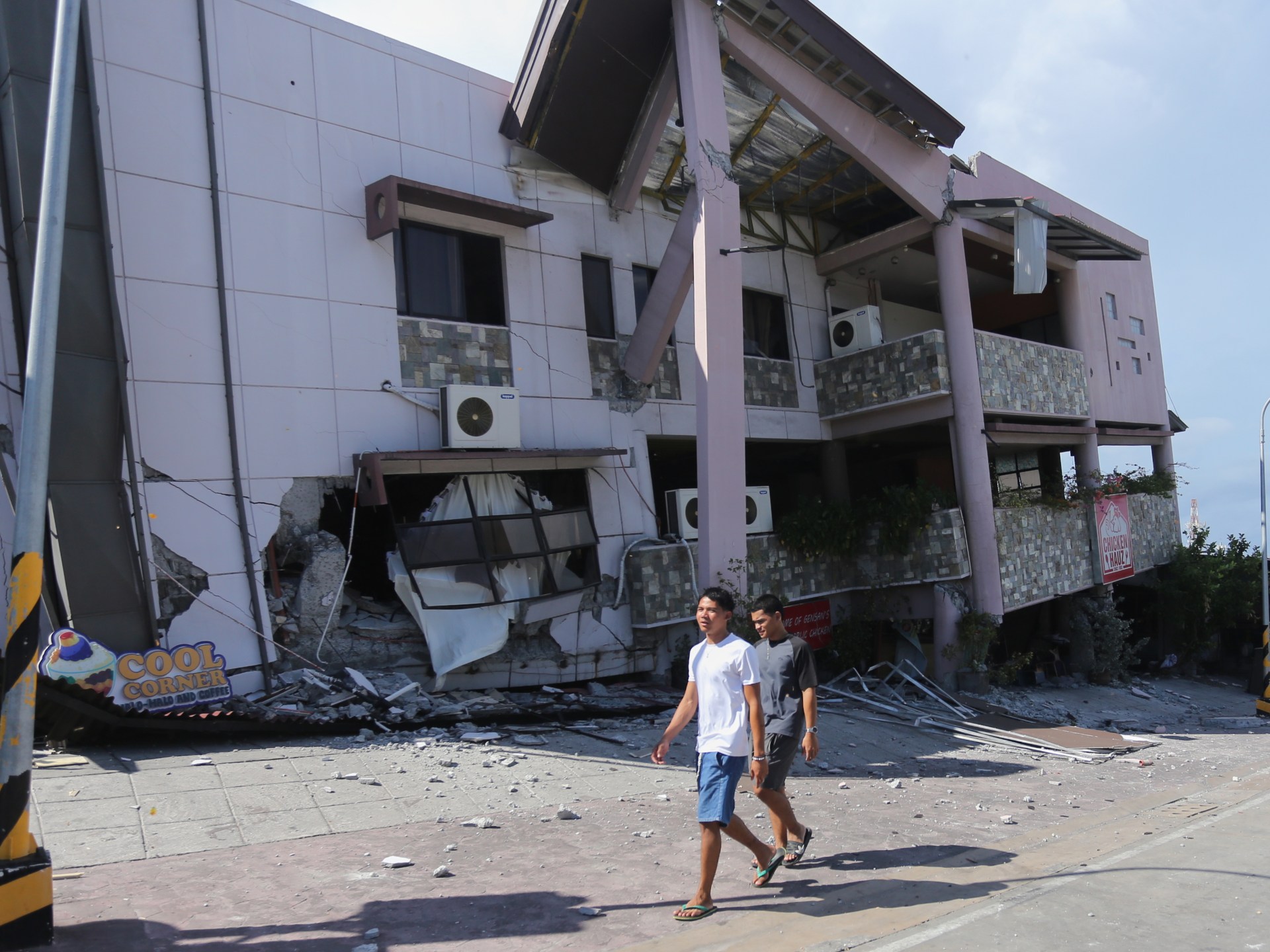
General Santos, a coastal city of about 720,000 people, was among the hardest-hit areas. Rescue teams searched the remains of a collapsed commercial building that housed a grocery store, where two people were believed to be trapped. Officials said two survivors had been pulled from the debris and a third person was found dead. Scanners had detected no signs of life from those still missing, Al Jazeera reported.
“It’s difficult to accept, as a mother, that my son is still trapped there,” Dioslinda Deluvio said as she waited outside the building. “My only call is to have him retrieved today so we can be at peace.”
At least 13 people died in General Santos in collapsed buildings and from falling debris, while at least 18 others died in Sarangani province, mostly in a landslide that buried houses in the mountainside town of Glan, Al Jazeera reported. Additional deaths were reported in South Cotabato, Davao Occidental and Balut Island.
The earthquake struck shortly before 7:40 a.m. local time Monday, about 20 kilometers off the coast of Sarangani province. Tremors were felt as far as Manado on Indonesia’s Sulawesi island, about 420 kilometers away. The United States Geological Survey recorded a series of strong aftershocks over the next two hours, the largest measuring magnitude 6.5.
The quake triggered tsunami warnings in Indonesia, south of Mindanao and along Japan’s Pacific coast, displacing tens of thousands of people. Those warnings followed movement on the Cotabato Trench off the southern Philippines, the BBC reported. The same trench generated a magnitude 7.9 earthquake in 1976 that caused a tsunami and killed about 5,000 people.
Across Mindanao, buildings collapsed, roads cracked or disappeared under landslides, and large areas remained without electricity or phone service. Alejandro said close to 2,000 homes and 6,000 public schools had been damaged by initial estimates. Al Jazeera reported about 117 government buildings were also damaged and that about 6,000 public school buildings would need assessment before classes could resume.
In several schools, officials said children avoided greater harm because they were outside for Monday flag ceremonies when the shaking began. In Lebak town, public school teacher Cesar Sundo said the ground rocked for more than two minutes.
“Everyone felt dizzy, like we were being vigorously rocked on a hammock for more than two minutes. And the shaking was getting stronger by the second,” Sundo said. “Our students were shouting and crying while we needed to calm them down. And it was thousands of students.”
“We were literally saved by our flag ceremony,” he said.
Science minister and veteran seismologist Renato Solidum said many students survived because they were outside. “They were lucky to be outside. They were able to stay put and sit down,” he told DZMM. “These areas have experienced strong earthquakes before. This is one of the strongest.”
Access to some towns remained difficult. In Jose Abad Santos in Davao Occidental, Mayor Jason John Joyce said landslides buried the town’s only highway, leaving half of it reachable by road. “Relief goods have to be flown in to far-flung barangays,” he said.
President Ferdinand Marcos Jr. said emergency agencies had been activated and government officials, including the transportation and health secretaries, had gone to Mindanao to oversee the response. “The national government is moving and we will not leave Mindanao behind,” Marcos said.






Be First to Comment