Key takeaways:
- At least 35 people were killed after a magnitude-7.8 offshore earthquake struck Mindanao on Monday morning.
- The BBC reported at least 134 injuries and about 10,000 families displaced, while Al Jazeera reported more than 200 injuries.
- Tsunami alerts in the Philippines, Indonesia, Japan and Australia were later lifted or downgraded after waves up to 1.4 metres were detected in some areas.
A powerful magnitude-7.8 earthquake struck off the southern Philippines on Monday, killing at least 35 people, injuring scores more and sending tsunami alerts across parts of the Pacific before officials later lifted or downgraded the warnings.
The quake hit at 07:37 local time Monday, or 23:37 GMT Sunday, off the coast of Mindanao, the Philippines’ second-largest island and home to about 26 million people. Teresito Bacolcol, director of the Philippine Institute of Volcanology and Seismology, told Al Jazeera it was the strongest earthquake to hit the country this year. He said the epicenter was about 32km, or 20 miles, southwest of Maasim town in Sarangani province, at a depth of 33km, or 20 miles.
The Philippines’ Office of Civil Defense said Monday afternoon that 31 deaths were recorded in Soccsksargen and four in Davao, the BBC reported. Officials had earlier put the toll at 32 dead, with 12 people missing. The BBC reported at least 134 people injured and about 10,000 families displaced, while Al Jazeera reported more than 200 injuries.
The toll remained subject to verification by the national disaster agency, which compiles and checks reports from local authorities and is expected to provide an official update in the coming days.
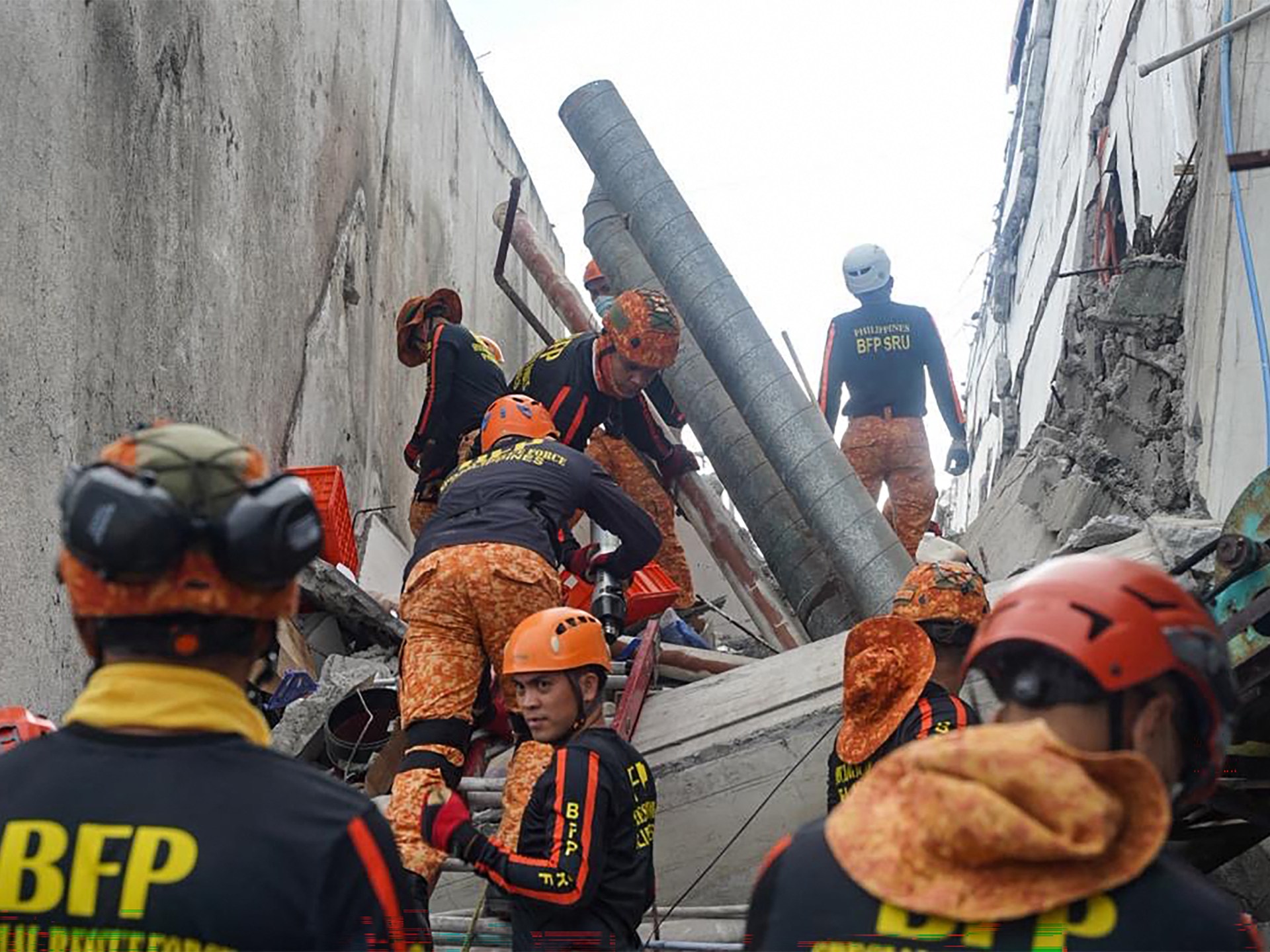
Images and videos from the affected region showed damaged and collapsed buildings, including footage of a Jollibee fast food restaurant reduced to rubble. Several low-rise buildings collapsed or were badly damaged in General Santos, Al Jazeera reported. Landslides were also recorded in some areas.
In Glan, a municipality in Sarangani province, a landslide killed 13 villagers, provincial disaster-mitigation official Rene Punzalan told the DZBB radio network, according to Al Jazeera. Four other villagers died in Sarangani, he said. Disaster-mitigation official Ednar Dayanghirang said most of the other deaths were caused by collapsing buildings and falling debris, including in a damaged mosque, in South Cotabato, Davao Occidental and on Balut Island, Al Jazeera reported.
President Ferdinand Marcos Jr. said national agencies were coordinating the response and ordered classes suspended in affected areas, where the quake struck on the first day of the school year. “The national government is moving and we will not leave Mindanao behind,” Marcos said.
A video posted by a primary school in Davao Occidental showed dozens of frightened students squatting on the shaking ground as a corrugated-roof shelter collapsed behind them. The school said no one was injured.
The quake triggered tsunami alerts in the Philippines, Indonesia, Japan and Australia. Authorities cancelled or downgraded the warnings hours later. The Pacific Tsunami Warning Center said the tsunami threat had largely passed about five hours after the quake, and Philippine officials lifted their warning by mid-afternoon.
Japan had warned of possible one-metre waves reaching its shores. A wave of a few centimetres was later observed in Okinawa, while a 20cm wave was recorded in the distant Ogasawara Islands. Waves were also detected along coasts in Indonesia, Palau and the Philippines, ranging from a few centimetres to 1.4 metres, according to authorities. Al Jazeera reported tsunami damage in at least one southern coastal village, where officials said six shanties on stilts were damaged in Zamboanga del Sur province by the quake and higher waves.
More than 130 aftershocks followed the main quake, with magnitudes ranging from 1.3 to 6.7. A magnitude-5.7 earthquake also struck waters off Balut Island in Sarangani at about 22:52 local time.
The United States said it was coordinating with Manila and was ready to support Philippine response efforts, while France, Japan and New Zealand also expressed support, Al Jazeera reported.
Earthquakes are common in the Philippines, which lies on the Pacific “Ring of Fire,” an arc of seismic faults around the ocean. Last September, a magnitude-6.9 earthquake struck the central Visayas region, killing more than 70 people.




Be First to Comment