Key takeaways:
- David Lammy said he told JD Vance he was wrong to link Henry Nowak’s murder to mass migration.
- Vickrum Digwa, a British-born Sikh man, was convicted of murdering Nowak and sentenced to life in prison.
- The Independent Office for Police Conduct is investigating Hampshire Police after officers handcuffed Nowak as he lay dying.
Deputy Prime Minister David Lammy said he told U.S. Vice President JD Vance he was “wrong” to link the murder of British teenager Henry Nowak to mass migration, after Vance’s comments drew criticism from Downing Street and renewed debate over policing in the case.
Lammy, who is also justice minister, said he spoke to Vance by phone on Saturday after the vice president posted on X that Nowak’s death showed the need for “righteous anger” and blamed it in part on “the mass invasion of migrants.”
“I told him he was wrong,” Lammy told the BBC’s Sunday with Laura Kuenssberg programme. He said he told Vance the killing “has got nothing to do with mass migration.” Speaking to Sky News, Lammy described the call as “robust” but “agreeable,” saying he wanted “to present the facts to him.”
Nowak, an 18-year-old British student, was fatally stabbed in Southampton in December by Vickrum Digwa, 23. Digwa is British and was born in the United Kingdom. He was convicted of murder and sentenced this week to life in prison, with NPR reporting a minimum term of 21 years.
Digwa, who is Sikh, falsely told police he had been racially abused and had acted in self-defence. He used a Sikh dagger, described by NPR as an 8-inch, or 21-centimeter, blade; the BBC reported that Digwa claimed he carried the blade for religious reasons linked to his Sikh faith.
Bodycam footage showed officers handcuffing Nowak as he lay dying after Digwa claimed he was the victim of a racist attack. NPR reported that police initially treated the wounded Nowak, who was white, as a suspect before noticing his injury and trying to resuscitate him. The Independent Office for Police Conduct is investigating Hampshire Police’s response. The head of Hampshire Police has told the BBC the force was “sorry for handcuffing and arresting Henry.”
Vance wrote Friday that Nowak had died “the same way a civilisation dies: abandoned and handcuffed by authorities who neither trusted nor cared for him.” He said Nowak would still be alive “if the last few generations of European elites had stood their ground against the politics of self-hatred and the mass invasion of migrants.”
Lammy said he also rejected Vance’s “caricature” of Western civilisation and its perceived decline. “We remain colleagues and friends, we’re able to do that, and he has strongly held views,” Lammy said.
He said he reminded Vance that Nowak’s family had called for calm. Mark Nowak, Henry’s father, said outside court after sentencing: “We do not want his death to be used to create further division, hatred or tension.” NPR reported that Mark Nowak has also said the case was not about racism or religion and that he wanted his son’s death to lead to safer streets.
Downing Street, responding to Vance’s remarks, criticized “people trying to interfere in our democracy and seeking to stir up division.”
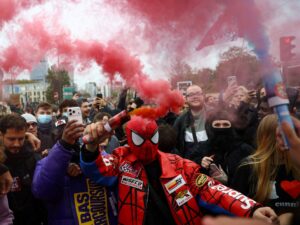
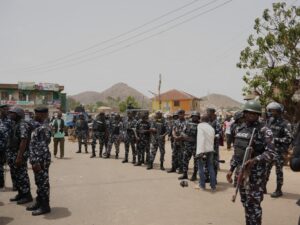
The killing has sparked a fierce debate in Britain over policing and knife laws. Violent protests erupted in Southampton; NPR reported police were pelted with chairs, cans, rocks and flares after a demonstration over Nowak’s death attended by far-right figures and others.
A National Police Chiefs’ Council document on anti-racism commitments has also come under scrutiny. The document says racial equality “does not mean treating everyone ‘the same’ or being ‘colour blind.’” The NPCC said Tuesday it would review the language used in the document.
Reform UK home affairs spokesman Zia Yusuf told the BBC there was a direct link between what he called police “guidance” and what happened to Nowak. He said the party had been respectful of the family’s wishes but would keep making its arguments through politics. “Nobody is going to guilt trip us into not making these arguments,” Yusuf said.
Asked about the police, Lammy said “we are all equal before the law,” while adding that ethnic minorities remain disproportionately represented in arrests, prosecutions, convictions and prisons. He said Britain had “moved on from that period of institutional racism” in policing, adding: “That’s not my experience when I see policing.”





Be First to Comment