Key takeaways:
- Saudi officials reported 12 deaths, including one American, and 309 injuries in Saturday’s airport strike.
- The Houthis had not claimed Saturday’s strike, but claimed earlier airport attacks that killed three Saudis.
- Airport operations were suspended, and at least 291 flights had been canceled over 24 hours.
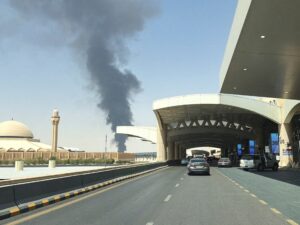
A strike on Riyadh’s main airport killed at least 12 people and injured 309 on Saturday, Saudi officials said, as President Donald Trump weighed whether the United States should join Saudi attacks on Houthi rebels in Yemen.
The dead included an American, four Saudi citizens, two Bangladeshis and one person each from Egypt, Jordan, Syria, Palestine and Sudan, according to Saudi Arabia’s General Authority of Civil Aviation. Several of the injured were in critical condition. A regional official said a missile struck a complex housing terminals 3 and 4, which serve domestic flights. The official spoke on condition of anonymity because they were not authorized to speak to the media.
The Iran-backed Houthis did not immediately claim responsibility for Saturday’s strike. They claimed attacks earlier in the week on King Khalid International Airport that killed three Saudis, including a pilot. The latest assault came during a surge of strikes on Saudi airports, military facilities and oil infrastructure following a major Saudi-led offensive against the Houthis launched this past week.
Asked Saturday whether the U.S. might join the Saudi strikes, Trump said, “We may. We’re gonna look at it.” He said he had just learned of the airport attack and that a decision would come quickly. A State Department spokesperson condemned “Houthi terrorist attacks against civilian infrastructure and airports” and told CBS News the department was in close contact with Saudi officials.
Saudi aviation authorities suspended operations at King Khalid. An official notice said the closure would last through midnight. Police blocked airport entrances, flights were diverted and at least 291 flights had been canceled over the preceding 24 hours, according to FlightAware. The United States, Britain, Germany, Australia and Canada warned their citizens to avoid the airport. Air India, FlyDubai, Lufthansa Group and Pakistan International Airlines were among carriers that had already suspended some Saudi flights for varying periods.
The Houthis warned airlines this week “for the last time” about flying in Saudi airspace, which they described as a theater of military operations. The European Union Aviation Safety Agency also expanded its guidance, citing the rebels’ ability to reach Riyadh and their “greater focus on aviation infrastructure.” Missile and drone attacks, along with efforts to intercept them, “create an increased risk of misidentification of civil aircraft,” the agency said.
In Yemen, Saudi-backed government forces are trying to reverse Houthi gains along the Red Sea with air support from the Saudi-led coalition. Those gains have improved the rebels’ ability to monitor shipping near the Bab al-Mandab Strait, a route that offers an alternative to the Strait of Hormuz. The Houthis have said they are targeting only Saudi shipping as part of a blockade in retaliation for one imposed on them.
The Associated Press reported that regional officials said Saudi Arabia was running low on missile interceptors and had sought air defense support from France, Britain, Pakistan and Egypt. Saudi Arabia also said Saturday that its foreign minister and Omani counterpart had discussed diplomatic solutions to reduce regional tensions. Earlier that day, the Houthis accused Saudi Arabia of striking the airport in Yemen’s capital, Sanaa.





Be First to Comment