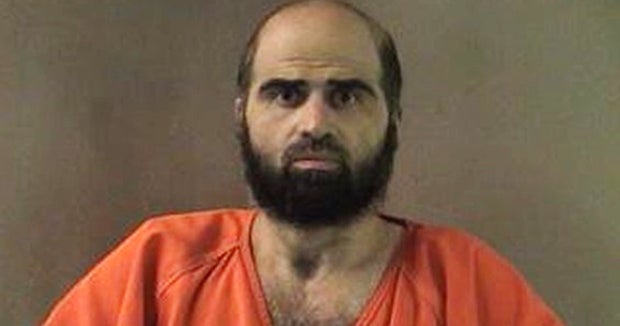
Key takeaways:
- Hasan’s execution is scheduled for 1 p.m. Dec. 3 at Fort Hood, and a Defense Department official says it will be livestreamed.
- Hasan was sentenced to death in 2013 for a 2009 attack that killed 13 people and wounded 32, according to NBC News.
- The military has not carried out an execution since 1961 or used a firing squad since 1945.
The U.S. military plans to livestream the firing squad execution of Nidal Hasan, the former Army psychiatrist convicted of killing 13 people at Fort Hood, Texas, in 2009, a Defense Department official said. The execution is scheduled for Dec. 3 at the base, making it the first U.S. military execution in more than 60 years if carried out.
Defense Secretary Pete Hegseth said Thursday that soldiers would conduct the execution at 1 p.m., the same time of day as Hasan’s attack. “We’ll make sure that people are able to watch it, that it’s public,” Hegseth told Real America’s Voice. “Because people need to understand that there’s serious consequences for these types of things.” The Pentagon has not said which platform will carry the livestream.
President Donald Trump approved Hegseth’s recommendation to use an Army firing squad, chief Pentagon spokesperson Sean Parnell said on social media. Hegseth called that method a “no-brainer.” Asked whether Hasan had contacted Trump or made any final requests, he replied: “Don’t care. We’ll see him on Dec. 3rd.”
Hasan, then an Army major, opened fire in a crowded medical building at Fort Hood on Nov. 5, 2009, as soldiers awaited medical checks before deployment. He killed 13 people and wounded 32, according to NBC News. The BBC described it as the deadliest non-combat attack on a U.S. military base. Hasan was shot during the attack and paralyzed from the waist down.
At his 2013 court-martial, Hasan acknowledged carrying out the shooting. CBS News reported that he said he wanted to protect Islamic insurgents from U.S. forces. A military jury convicted him of premeditated murder and sentenced him to death. He represented himself at trial, with standby Army lawyers available to assist him.
The Guardian reported that investigators found Hasan had exchanged 18 emails before the attack with Anwar al-Awlaki, a radical cleric later killed in a U.S. drone strike. A review led by former FBI Director William Webster concluded that the bureau should have investigated the correspondence more thoroughly.
Hasan asked the Supreme Court to review his case in 2024, arguing that the trial judge had improperly cleared the courtroom during discussions about his lawyers. The court declined to take the case last year, CBS News reported. The Guardian said Hasan exhausted his appeals last year, while NBC News reported that a person sentenced to death by a military court may seek habeas relief in federal court after presidential approval. It is not clear whether Hasan will challenge the execution method.
The last U.S. military execution took place in 1961, when Army Pvt. John Bennett was hanged after his conviction for raping and attempting to kill an 11-year-old girl. The military last used a firing squad in 1945, executing Pvt. Eddie Slovik for desertion during World War II. CBS News said making an execution viewable to the general public is virtually unheard-of in recent U.S. history.









Be First to Comment