Key takeaways:
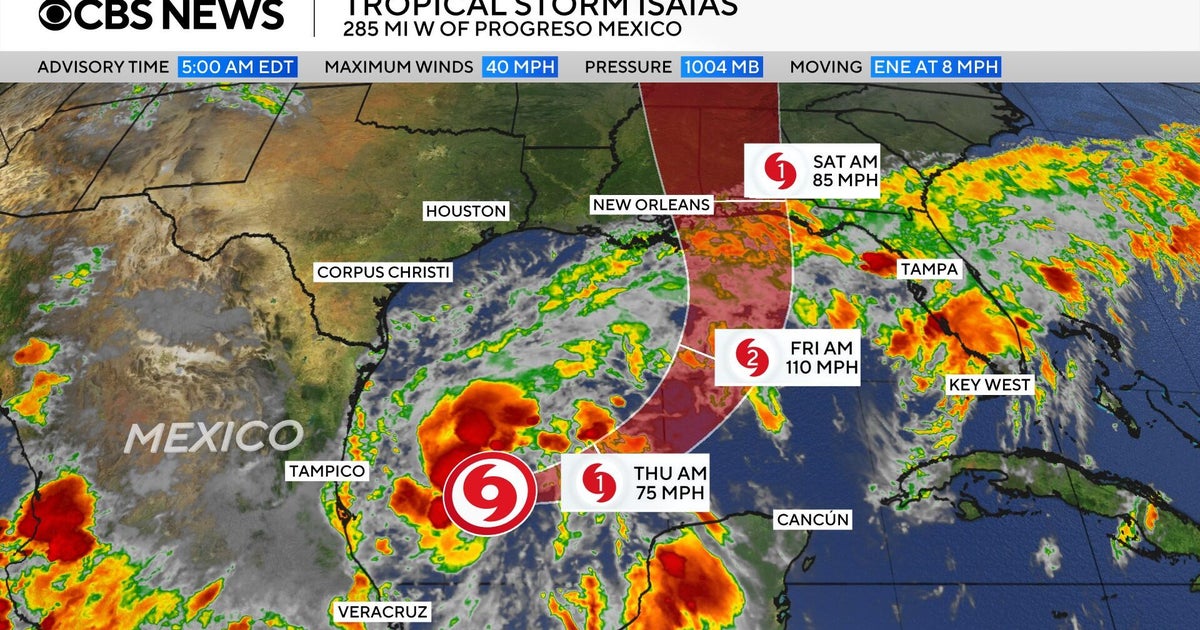
- Isaias had maximum sustained winds of about 75 mph late Wednesday and could make landfall between the Mississippi coast and Florida Panhandle late Friday or early Saturday.
- Forecasters warned of storm surge up to 7 feet along part of the northern Gulf Coast and rainfall up to 10 inches in some coastal areas.
- Florida declared an emergency in 25 counties and Alabama in 40, while roughly 25% of Gulf oil production was temporarily halted.
Isaias strengthened into the Atlantic season’s first hurricane late Wednesday, with forecasters expecting it to approach the U.S. Gulf Coast on Friday and make landfall late Friday or early Saturday. Warnings stretched across the northern Gulf Coast as communities prepared for dangerous storm surge, heavy rain and flooding.
The National Hurricane Center put Isaias’s maximum sustained winds at about 75 mph in a late Wednesday advisory, just above the 74 mph hurricane threshold. Its center was about 460 miles south-southwest of the Mississippi River, moving east-northeast at 9 mph, according to NPR. The storm had formed earlier Wednesday in warm waters off eastern Mexico.
Isaias could make landfall between the Mississippi coast and the Florida Panhandle, NPR reported. A hurricane warning covered the coast from Ocean Springs, Mississippi, to Florida’s Bay/Gulf county line, according to CBS News. Tropical storm warnings extended west to the Jefferson/Plaquemines Parish line in Louisiana and east to Florida’s Aucilla River. A storm surge warning ran from the mouth of the Mississippi River to Yankeetown, Florida.
At high tide, a roughly 300-mile stretch from Ocean Springs to Indian Pass, Florida, could see storm surge of up to 7 feet, CBS News reported. Forecasters projected 3 to 7 inches of rain along the central Gulf Coast, from southeastern Louisiana to the Florida Panhandle, with as much as 10 inches in some places. Much of the Southeast, the Tennessee Valley and the Carolinas could receive 1 to 5 inches.
The hurricane center warned of “an increasing risk of dangerous wind and storm surge impacts” and urged people in Louisiana, Alabama, Mississippi and northern Florida to monitor forecasts and have hurricane plans ready. It also warned of possible urban and isolated river flooding.
Florida Gov. Ron DeSantis declared a state of emergency for 25 counties in the Panhandle and Big Bend regions. Alabama Gov. Kay Ivey did the same for 40 counties. “While I hope for minimal impacts, we must take preparations seriously,” Ivey wrote on X. Florida’s declaration allows officials to deploy disaster responders and equipment, and the state planned to deploy a Miami-based urban search and rescue task force, NPR reported.
The approaching storm was already disrupting work and travel. About 25% of Gulf oil production had been temporarily halted as of Wednesday, taking roughly 511,000 barrels a day off the market, according to figures reported by NPR. Eight of the region’s 371 manned oil platforms had been evacuated. “I would characterize the oil market risk as moderate, but rising,” Jim Burkhard, an S&P Global Energy oil market researcher, told NPR.
Organizers canceled the National Shrimp Festival in Gulf Shores, Alabama, which NPR said drew an estimated 325,000 people last year. Gulf Shores and nearby Orange Beach encouraged voluntary evacuation in low-lying areas. In Pensacola, Florida, utilities positioned repair crews and officials provided sand for residents to fill sandbags. Mayor D.C. Reeves urged people to check on neighbors who might need help. “Obviously no need to panic at this point,” he said. “This is really about preparation.”







Be First to Comment