Key takeaways:
- Ratko Mladic died at 84 while serving a life sentence in The Hague for genocide, war crimes and crimes against humanity.
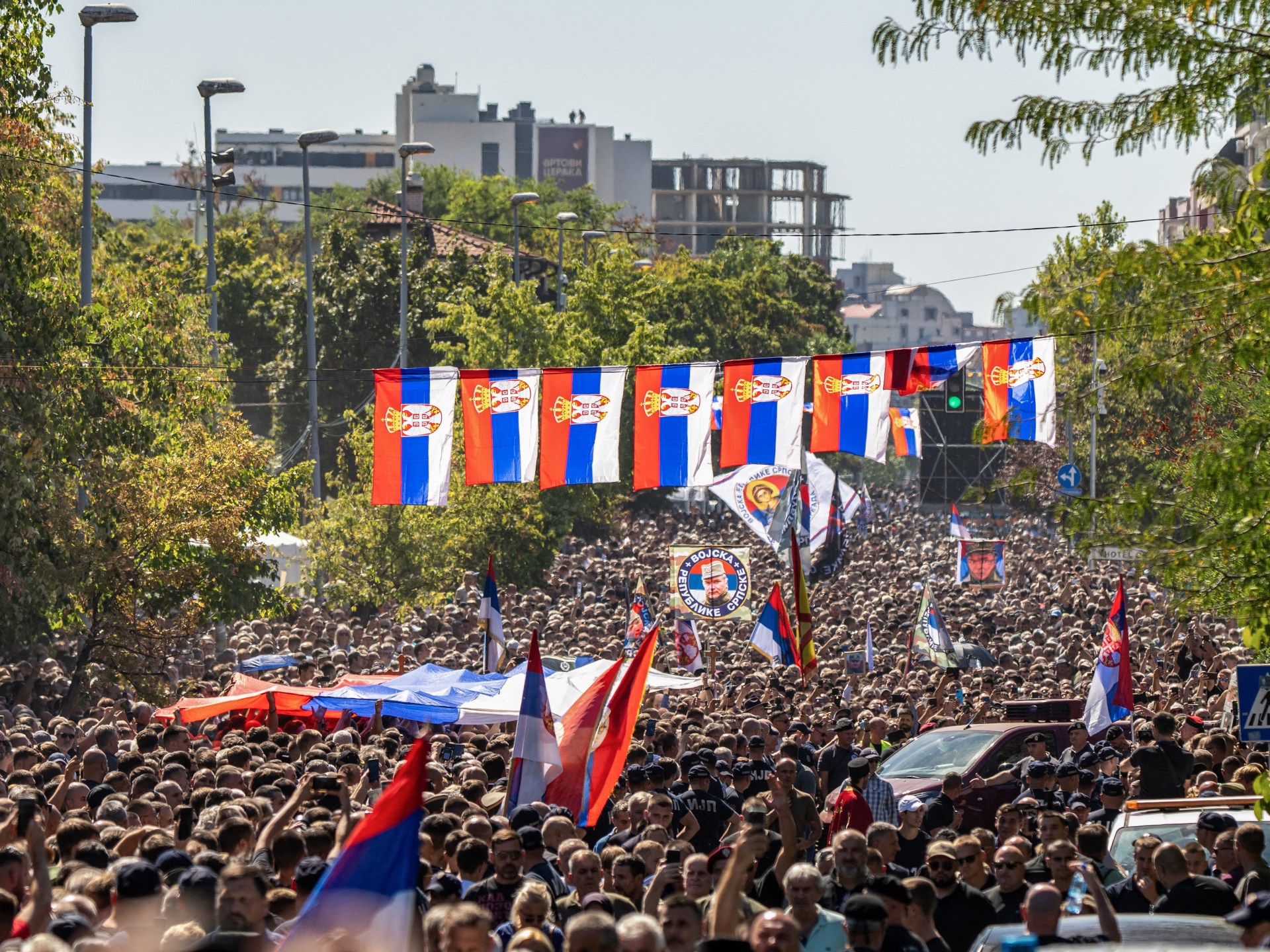
- Thousands attended his Belgrade funeral, where he lay in state at St. Luke church and was buried in a Serbian flag-wrapped coffin.
- The EU condemned the “glorification” of Mladic, saying it contradicts fundamental European values and has no place in EU candidate countries.
Thousands of mourners gathered in Belgrade on Monday for the funeral of Ratko Mladic, the former Bosnian Serb military commander convicted of genocide, war crimes and crimes against humanity for atrocities committed during the 1992-1995 war in Bosnia and Herzegovina.
Mladic, 84, died on Aug. 27 while serving a life sentence in a United Nations prison in The Hague. Widely known as the “Butcher of Bosnia,” he was found guilty by a UN war crimes tribunal over his role in the 1995 Srebrenica massacre, in which more than 8,000 Bosniak Muslim men and boys were killed after Bosnian Serb forces captured the UN-declared safe area. The killings have been ruled a genocide and are widely described as Europe’s worst atrocity since World War II.
His body was returned to Serbia last week on a government plane, a move that drew condemnation in the region and beyond. The coffin was carried from the aircraft by six soldiers and draped in flags, the BBC reported. On Monday, Mladic was buried in a coffin wrapped in the Serbian flag, with military honours and the participation of government members, according to Al Jazeera.
A Serbian government minister initially said Mladic would receive a state funeral, but those plans were changed after objections from European leaders. The European Union denounced what it called Mladic’s “glorification.”
“Ratko Mladic was a convicted war criminal who had committed war crimes, genocide, and crimes against humanity,” the EU said in a statement. “Any glorification of war criminals, genocide denial and revisionism contradict the most fundamental European values and have no place in the EU or in EU candidate countries.” Serbia has been a candidate for EU membership since 2012, though talks have recently stalled.
European Commissioner for Enlargement Marta Kos cancelled an official visit to Belgrade last week over the funeral, saying “the glorification surrounding his death is incompatible with the values on which the EU path is built,” Al Jazeera reported. UN Secretary-General Antonio Guterres also warned against actions that glorify convicted war criminals.
From early morning, long lines formed outside St. Luke church, where Mladic lay in state before burial. Many mourners were army veterans, and some men were draped in flags bearing his image. His wife, son and grandchildren received condolences inside the church. The funeral service was led by Serbian Orthodox Church Patriarch Porfirije, who said Mladic’s name would remain “deeply etched in the memory and prayers of the majority of our Serbian Orthodox people, who feel and nurture a deep sense of gratitude towards him.”
Several Serbian government ministers joined crowds outside the church, including Defence Minister Bratislav Gasic and Justice Minister Nenad Vujic, local media reported, according to the BBC. Al Jazeera reported that Serbian opposition figures, former and current officials from Republika Srpska, pro-Serbian politicians from Montenegro and Russia’s ambassador to Serbia, Alexandar Botsan-Kharchenko, also attended. Serbian President Aleksandar Vucic did not attend, though Al Jazeera reported that his son, Danilo, was present. Mladic’s family had publicly thanked Vucic for his support, and Vucic backed what he described as a “dignified funeral.”
The funeral underscored Mladic’s divisive legacy. Many Serb nationalists regard him as a hero and protector, especially in Republika Srpska, where his death prompted vigils. Free bus services were organised from Bosnia and many Serbian towns for people wishing to pay respects, the BBC reported. Red Star Belgrade football fans unveiled a display of Mladic before a derby win over Partizan Belgrade on Sunday night.
For survivors and victims’ families, the ceremony reopened wounds. Zdravka Gvozdjar, a Sarajevo woman whose nine-year-old son was killed by Mladic-led forces during the siege of the city, told Reuters it was “really horrible” that the funeral was taking place in Belgrade. Mladic “deserved to be erased from memory for good, not to be… promoted as a hero,” she said. “He should be remembered only as a butcher.”




Be First to Comment