Key takeaways:
- The Nancy Grace Roman Space Telescope is scheduled to launch at 7:26 a.m. ET Sunday from Kennedy Space Center on a SpaceX Falcon Heavy rocket.
- Roman is designed to scan the sky 1,000 times faster than Hubble and discover more than 100,000 exoplanets during its mission.
- The telescope will travel to Lagrange Point 2, about 1 million miles from Earth, where the James Webb Space Telescope also operates.
NASA is set to launch its next major space observatory Sunday, sending the Nancy Grace Roman Space Telescope on a $4.3 billion mission to map the universe faster and more broadly than any space telescope before it.
The telescope is scheduled to lift off at 7:26 a.m. ET from NASA’s Kennedy Space Center in Florida aboard a SpaceX Falcon Heavy rocket. NASA plans to begin live coverage at 6:20 a.m. ET on its website and other platforms.
Roman is designed to survey hundreds of millions of stars and billions of galaxies during a five-year primary mission. Scientists expect it to capture panoramic views of the cosmos, study dense regions of the Milky Way and discover more than 100,000 planets beyond the solar system. Its observations also aim to sharpen understanding of dark matter and dark energy, two of astronomy’s central mysteries.
“Some of our longest-standing mysteries in modern astrophysics are: What is the nature of dark matter and the nature of dark energy?” said astrophysicist Neil deGrasse Tyson, director of the Rose Center for Earth and Space at the American Museum of Natural History in New York City. “We have ideas, but we don’t know what they are. This telescope is going to try to give us the best data available to address those questions.”
NASA Administrator Jared Isaacman said the mission is expected to shed light on “dark matter, dark energy and the structure of the universe itself and accelerate the… discovery of potentially habitable planets outside our solar system.” He added, “Roman will give the Earth a new atlas of the universe.”
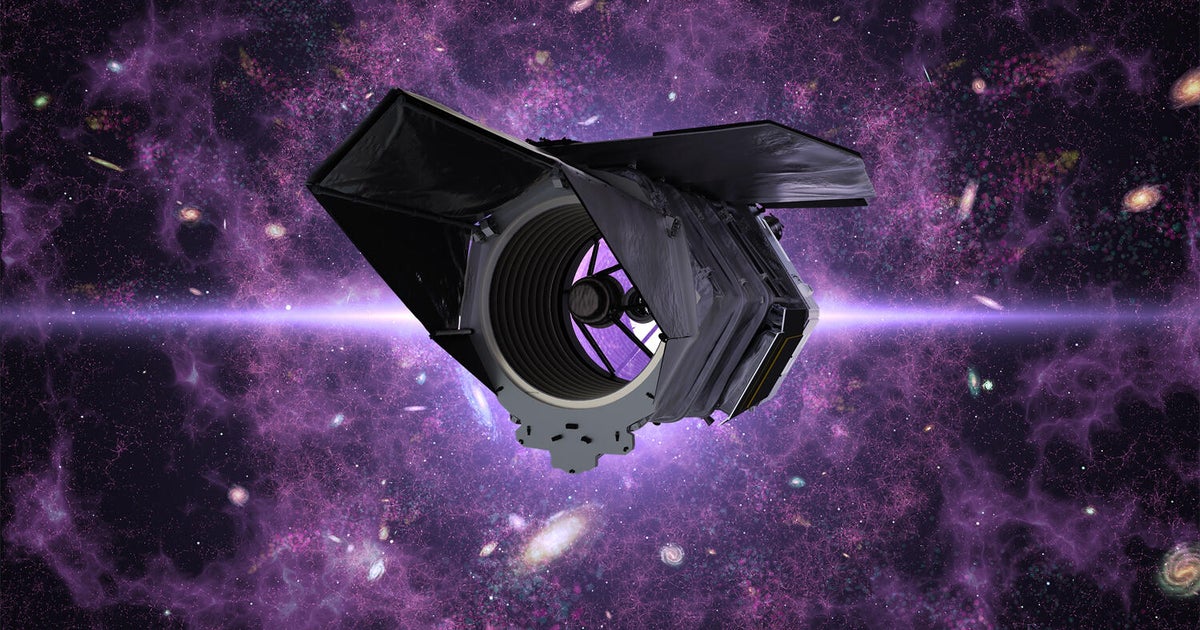
The 42-foot-long, 18,000-pound observatory is often compared with the Hubble Space Telescope, which launched in 1990. Roman carries a Hubble-class mirror and is expected to scan the sky 1,000 times faster than Hubble, with each image covering at least 100 times more sky. CBS News reported that its 300-megapixel wide-field camera could produce a single full-resolution image large enough to cover 45 city blocks or all of El Capitan in Yosemite National Park, and that displaying one image in full would require half a million 4K televisions.
NASA science chief Niki Fox called Roman “a sheer powerhouse” and “literally a speed machine.” She said, “The speed at which we’ll be scanning the sky, delivering vast amounts of data and returning results will be at an unprecedented rate, never done before.”
After launch, Roman will spend more than three months traveling to Lagrange Point 2, or L2, about 1 million miles from Earth. There, the gravitational pull of the sun and Earth allows spacecraft to maintain a stable position with minimal fuel. NASA’s James Webb Space Telescope also operates in that region.
Three core surveys are planned. The largest will last more than a year and look through the Milky Way’s star-packed center, known as the galactic bulge, to build a vast catalog of astronomical objects. The others will focus on dark matter, the invisible material inferred through its gravitational effects, and dark energy, the force scientists think is accelerating the universe’s expansion.
Roman also carries an advanced coronagraph designed to block starlight so scientists can detect the far dimmer light reflected by orbiting planets. Vanessa Bailey, the Roman coronagraph instrument scientist at NASA’s Jet Propulsion Laboratory, said researchers hope to see “a Jupiter twin around a nearby star using visible light reflected from its cloud tops for the first time” and use that light to study its atmosphere.
The mission is named for Nancy Grace Roman, NASA’s first chief of astronomy, who took the post in 1959 and helped win congressional approval for Hubble. Known as the “mother of Hubble,” she died in 2018. NASA named the new telescope after her in 2020.
The project has been under development for nearly two decades and is launching nine months ahead of schedule, despite the Covid pandemic and government shutdowns this year and last. CBS News reported that it also came in under budget.










Be First to Comment