Key takeaways:
- The wildfire grew from 80 hectares on Friday to 3,000 hectares by early Sunday, according to AFP citing local officials.
- About 600 people in Waimes and Butgenbach were told to evacuate Saturday as winds shifted and smoke spread.
- Firefighters from Belgium, Germany, Luxembourg and the Netherlands joined the response, supported by helicopters and Swedish water-bombing aircraft.
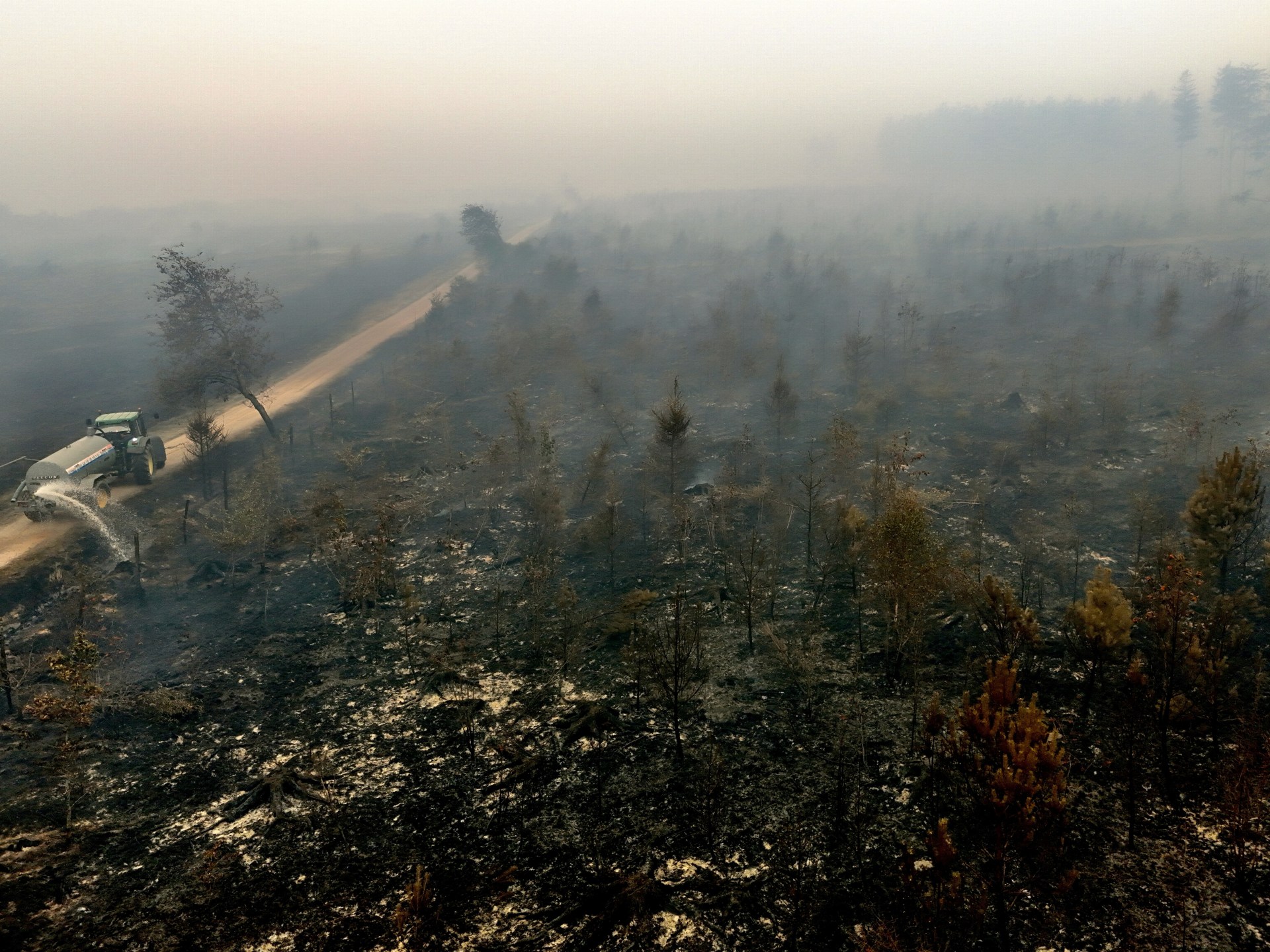
Belgium’s largest wildfire in recent history more than doubled in size over the weekend, tearing through the Hautes Fagnes nature reserve near the German border and forcing hundreds of residents from nearby communities.
Hundreds of firefighters and emergency workers spent a third day Sunday trying to contain the blaze in Belgium’s Liege province, where flames have burned across bog-like terrain, moorland and forest. The fire broke out Friday and spread rapidly, growing from 80 hectares that day to 850 hectares on Saturday morning and 3,000 hectares by early Sunday, AFP reported, citing local officials. Al Jazeera, citing authorities and Reuters, reported that the fire had burned more than 27 square kilometers, or 10.4 square miles.
Nicolas Yernaux, a spokesman for regional authorities in Wallonia, described the blaze on Saturday as the country’s “largest in recent history.” Al Jazeera reported that Belgium’s previous record fire occurred in 2011, when 14 square kilometers, or 5.4 square miles, burned in the same reserve, according to the European Forest Fire Information System.
Two nearby Belgian villages were evacuated as smoke and shifting winds threatened communities. About 600 people in the border municipalities of Waimes and Butgenbach were told to leave their homes Saturday, Al Jazeera reported. Authorities said no homes had been affected as of Sunday morning but urged people to stay away from the fire zone.
The fire has been spreading east toward Germany. The German town of Monschau said the flames had come within about 3 kilometers, or 1.9 miles, of the border. Officials there did not expect the fire to cross into Germany, but the town advised residents in three districts to leave temporarily because of smoke.
More than 250 emergency services personnel have been deployed, including firefighters from Belgium, Germany, Luxembourg and the Netherlands, Al Jazeera reported. Local farmers also hauled water tankers toward the reserve as crews battled the flames from the ground.
Aircraft from neighboring countries joined the response. Two water-bombing planes arrived from Sweden on Sunday afternoon to support four helicopters already at the site — two Belgian and two Dutch. Belgian officials said high heat and the reserve’s difficult terrain had complicated the effort. Yernaux said firefighters had “allowed parts of the heathland to burn because the area is very difficult to access.”
Belgian Interior Minister Bernard Quintin said two fire fronts, heading toward Jalhay and Monschau, had been brought under control. But officials said conditions remained challenging and that crews were relying heavily on aerial support. Rescue teams have not been able to reach the area where the fire began, leaving the cause unknown.
The Belgian fire is one of several burning across Europe after weeks of extreme heat and dry conditions. Forest fires have also been reported since Friday in Croatia, Spain and Serbia. In Landes, in southwestern France, local officials said a wildfire that began Thursday reignited Saturday and forced the evacuation of 650 residents, with more than 500 firefighters deployed.
On Sunday, at least two people were killed in forest fires on a Greek island off the coast of Athens, the BBC reported. Al Jazeera reported that thousands of people have been driven from their homes in Germany, France, the United Kingdom, Croatia and Greece in recent days, and that about 500,000 hectares, or 1.24 million acres, have burned across the European Union this year.
Belgium had just experienced another burst of severe heat, with temperatures reaching roughly 37C, or 98.6F, in places Friday. The European Union’s Copernicus climate monitoring service has confirmed that western Europe recorded its hottest June-to-July period on record.




Be First to Comment