Key takeaways:
- England and Argentina play Wednesday night in Atlanta for a place in Sunday’s World Cup final against Spain.
- The rivalry is tied to the Falklands/Malvinas dispute and the 1982 war, which NPR reported killed 649 Argentines, 255 Britons and three Falkland islanders.
- Argentina’s 1986 World Cup win over England featured Diego Maradona’s “Hand of God” goal and a second goal widely remembered as one of the greatest in tournament history.
England and Argentina meet Wednesday night in Atlanta for a World Cup semifinal shaped as much by history as by the chance to play for the trophy.
The winner will face Spain on Sunday, but the match between the reigning World Cup champions and England carries a weight built over decades: a war over disputed South Atlantic islands, Diego Maradona’s “Hand of God” goal, and a series of World Cup meetings that have left deep marks on both football cultures.
Argentina coach Lionel Scaloni has tried to lower the temperature. “It is a football game and that is all,” he said. NPR reported he also told fans it is “a football game, period.”
Few around the match are treating it that simply.
Lionel Messi, widely regarded as one of the game’s greatest players, is set to face England for the first time in his career. England will counter with all-time leading scorer Harry Kane and Jude Bellingham, one of the tournament’s standout players. Argentina will wear its dark blue away jersey, NPR reported, in an homage to the kit worn by Maradona’s team in its famous 1986 victory over England.
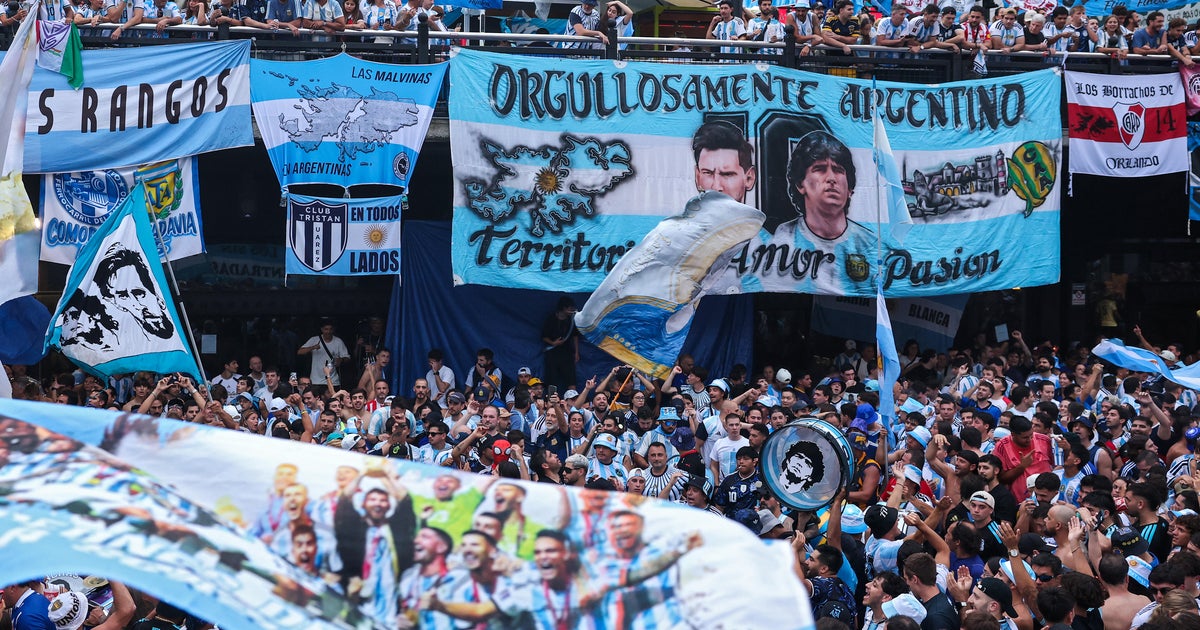
That match, a World Cup quarterfinal at Mexico City’s Azteca Stadium, remains central to the rivalry. Four years after Britain and Argentina fought over the islands known in Britain as the Falklands and in Argentina as the Malvinas, Maradona punched the ball into the net early in the second half. The referee missed the handball, and the goal stood.
Asked afterward whether it had been legal, Maradona said it was scored “a little with the head of Maradona, and a little with the hand of God.” Minutes later, he dribbled through England’s defense for a goal widely remembered as one of the greatest in World Cup history. Argentina won 2-1.
Maradona later connected the match directly to the war. In a 2019 documentary, he called the victory “like some sort of symbolic revenge against the English” for the Malvinas. NPR reported that he also said years later, “In that match we weren’t just playing football, we were playing for everything that had happened with the Malvinas war.”
The Falklands, or Malvinas, remain disputed. Britain considers them a British Overseas Territory. Argentina maintains a constitutional, historical and diplomatic claim. In 1982, Argentina’s military dictatorship sent troops to take control of the islands, and Britain responded with a naval force. NPR reported that 649 Argentines, 255 Britons and three Falkland islanders died before Argentina surrendered. CBS News reported the 10-week war killed 907 people, including more than a third who were Argentine sailors aboard the ARA General Belgrano, sunk by a British submarine in a controversial attack.
The issue remains visible in Argentina, where signs saying “the Malvinas are Argentine” appear in public spaces and the subject is taught in schools, NPR reported. Before Argentina’s quarterfinal win over Switzerland, Argentine Foreign Minister Pablo Quirno wrote on X: “Malvinas: the strength of a just cause. By history, right and conviction, the Malvinas are Argentine.” Nile Gardiner, director of the Margaret Thatcher Center for Freedom, replied: “This matter was decisively settled in 1982 with your emphatic defeat. Don’t try it again.”
Argentine media reported that U.S. officials deemed the Atlanta semifinal “high risk” and banned fans inside Mercedes-Benz Stadium from displaying signs or shirts mentioning the Malvinas, according to NPR.
The rivalry has produced other painful chapters. In 1998, Argentina beat England on penalties after David Beckham was sent off, a defeat former England captain Alan Shearer said Wednesday “still hurts now.” In 2002, Beckham scored a penalty in England’s 1-0 World Cup group-stage win over Argentina, the teams’ last competitive meeting.
After Argentina beat Switzerland 3-1 on Saturday, Messi and his teammates sang “The Fourth Star,” the country’s alternative World Cup anthem. “For Malvinas, for Diego,” they chanted.
England’s camp says it understands the stakes. Coach Thomas Tuchel said Argentina’s players “are fueled by history, it means a lot to them … But we are also emotional. We have the grit. We have the mentality that it takes to go up against it, and we are ready for it.”
Argentina forward Jose Lopez said the players would “leave our lives on the field,” adding: “Obviously, inside and outside the four lines of the pitch it’s a match that has a lot of history there, a lot of pain and a lot of things behind it.”










Be First to Comment