Key takeaways:
- The Senate voted 50-46 against opening debate on the National Defense Authorization Act, short of the 60 votes needed to advance.
- Democrats said the bill should not move forward while the Trump administration continues military operations in Iran without explicit congressional approval.
- The defense bill would authorize much of a $1.15 trillion military budget and includes a 3.6% troop pay raise, drone and counter-drone funding, shipbuilding measures and support for the B-21 bomber.
Senate Democrats blocked a major annual defense policy bill Tuesday, turning a normally bipartisan measure into a confrontation over President Donald Trump’s renewed military operations against Iran.
The Senate voted 50-46 against opening debate on the National Defense Authorization Act, denying the measure the 60 votes needed to advance. Senate Majority Leader John Thune, a South Dakota Republican, voted no in a procedural move that allows him to bring the bill back later.
“The NDAA, in my view, has become a referendum on the Iran war,” Democratic Sen. Richard Blumenthal of Connecticut told reporters.
The bill, one of Congress’ few must-pass measures, sets defense policy priorities and would authorize much of a $1.15 trillion military budget in line with Trump’s proposed spending plan, according to The Guardian and Al Jazeera. It includes a 3.6% pay raise for troops, investments in education, housing, health care and childcare, and funding for unmanned weapons, counter-drone technology and shipbuilding.
Democrats said they could not move ahead with the defense bill while the administration continues military action in Iran without explicit congressional approval. The 1973 War Powers Resolution requires a president to notify Congress within 48 hours of deploying forces when lawmakers have not authorized war, and limits unauthorized engagements to 60 days. The Trump administration has said hostilities “terminated” in April before resuming in recent days, CBS News reported.
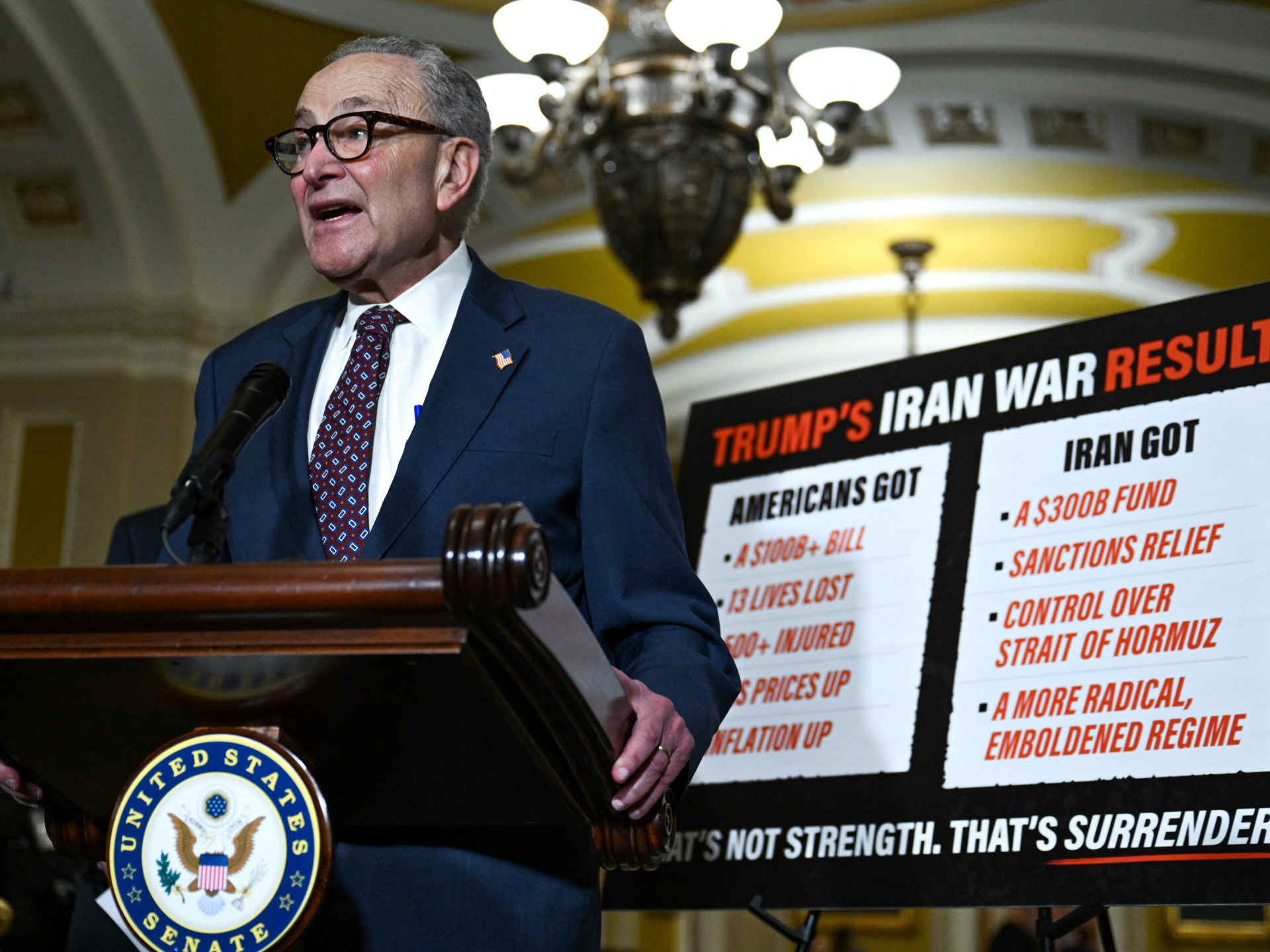
Senate Minority Leader Chuck Schumer said the White House formally notified Congress on Monday that hostilities had resumed in Iran, making Tuesday’s vote inappropriate.
“Republicans want the Senate to take up the NDAA, the defense bill, as though none of this is happening?” Schumer said before the vote. “As though Congress can debate the nation’s central national security bill while ignoring the nation’s most urgent national security crisis? We cannot. I will be voting no.”
Schumer accused Trump of “waging an unauthorized war, defying bipartisan majorities in Congress, refusing to level with the American people about the cost, the mission, or the end game.” He added: “The NDAA cannot become a permission slip for that recklessness that we see occurring in Iran.”
The Guardian reported that the vote came after the passage last month of a war powers resolution intended to force a ceasefire. The outlet also reported that Trump earlier this week threatened to impose a 20% “security” fee on vessels passing through the Strait of Hormuz, then backed down Tuesday while saying the United States would continue blocking Iranian ports. At a White House meeting with Iraqi Prime Minister Ali al-Zaidi, Trump said he opposed any strait fee, “but at the same time, it’s not fair that we’re protecting this strait for the entire world.”
Al Jazeera reported that some Democrats also objected to provisions in the defense bill that would deepen U.S. military and intelligence cooperation with Israel, as well as to the size of the Pentagon budget. The outlet said a coalition of 14 civil liberties, foreign policy and anti-war groups, including the American Civil Liberties Union, J Street, CODEPINK and Win Without War, urged lawmakers to oppose advancing the bill unless senators were guaranteed a vote on an amendment barring funding for what the groups called Trump’s unauthorized war against Iran.
Republicans criticized Democrats for blocking the measure. Thune said he saw “no reason” for Democrats to oppose it and accused them of obstruction.
“Republicans are ready to go,” Thune said. “The question is, how will Democrats vote today?”
“I certainly hope that Democrats won’t now put politics ahead of support for our men and women in uniform,” he added. “But that’s up to them.”
Thune said the bill would place a “heavy emphasis on unmanned systems, especially drones and counterdrone measures,” continue shipbuilding efforts “to strengthen our Naval fleet,” help maintain at least 1,800 fighter aircraft and support the new B-21 long-range strategic bomber. He also praised acquisition reforms, including expanded use of multiyear procurement contracts.
“Our colleagues on the Armed Services Committee have put forward a strong bill — a strong bill for our national security and for the men and women who defend our nation,” Thune said.






Be First to Comment