Key takeaways:
- A Singapore-flagged cargo ship was struck by an unknown projectile near Oman, damaging its bridge but causing no reported casualties or environmental impact.
- The International Maritime Organization paused a plan to evacuate more than 11,000 stranded sailors while it reassesses safety guarantees.
- The U.S.-Iran memorandum calls for 60 days of toll-free safe passage, but disputes remain over approved routes and possible future fees.
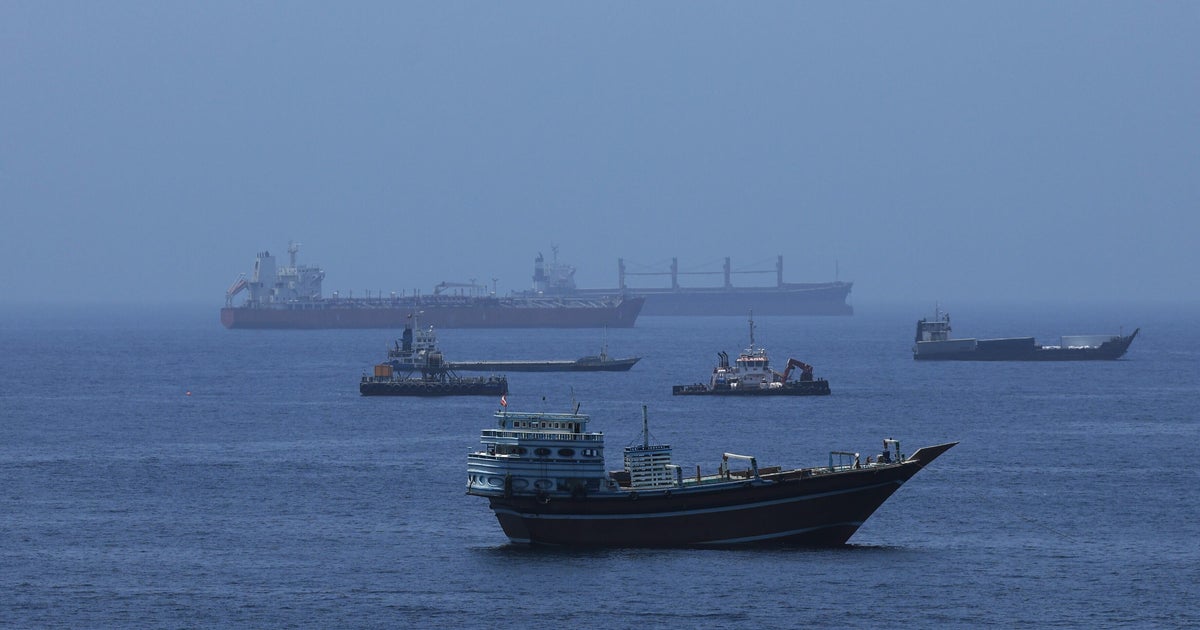
The United Nations’ maritime agency paused a plan to evacuate thousands of stranded sailors from the Strait of Hormuz after a Singapore-flagged cargo ship was struck by an unknown projectile off Oman, raising new doubts about a fragile U.S.-Iran deal to reopen the critical waterway.
The ship was hit Thursday about 7.5 nautical miles southeast of the Omani port of Dahit, the U.K. Maritime Trade Operations Centre reported. The vessel’s bridge was damaged after it was struck on its starboard side, but no casualties or environmental impact were reported.
A U.S. official confirmed to CBS News that Iran’s Revolutionary Guards attacked the commercial vessel. The BBC, citing maritime risk management firm Vanguard, identified the ship as the Singapore-flagged Ever Lovely and said it continued through the strait after the attack without needing assistance.
The International Maritime Organization said the vessel had already passed through the Strait of Hormuz and “did not transit under IMO’s evacuation framework.” Still, IMO Secretary-General Arsenio Dominguez said the agency was pausing its evacuation plan while it assessed whether safety guarantees remained in place.
“I have always reiterated that the safety of the seafarers remains paramount,” Dominguez said. “Therefore, to ensure a coordinated approach and navigational safety, the evacuation plan will be paused until further clarity is obtained.”
The IMO had announced the large-scale evacuation effort Tuesday to help more than 11,000 sailors stranded across hundreds of vessels in the Gulf. The plan followed last week’s memorandum of understanding between the United States and Iran, which included Iran’s commitment to use its “best efforts” to provide toll-free safe passage for commercial ships for 60 days.
The Strait of Hormuz is one of the world’s most important energy corridors. About one-fifth of global oil and liquefied natural gas supplies normally pass through the narrow waterway linking the Gulf to the Arabian Sea. Shipping there had been severely disrupted for months during the U.S.-Israel war against Iran, with hundreds of vessels and thousands of mariners stranded in the region.
Ship traffic had begun to recover after the agreement. Analytics firm Kpler said 70 vessels transited the strait on Tuesday or Wednesday, depending on the outlet reporting the data, compared with just six a week earlier, though it said some of the increase may reflect delayed traffic moving after the deal. Before the conflict, Al Jazeera reported, 120 to 140 vessels typically crossed each day.
The renewed movement helped push oil prices lower. The BBC reported that crude briefly fell below $72.48 a barrel Thursday before edging up to $73.23, while Al Jazeera reported Brent crude fell to $72.24, still above its pre-war price of $66.
Disagreements over routes and possible fees remain unresolved. The IMO said two evacuation routes were available: one through Iranian waters in the northern part of the strait and another through Omani waters in the south. Oman announced a new route Wednesday, saying it had coordinated with the IMO. Iran’s Islamic Revolutionary Guard Corps objected, saying the corridor had been announced without Tehran’s approval.
“Certain authorities have announced a new shipping route through the Strait of Hormuz without prior notification to or coordination with the Islamic Republic of Iran,” the IRGC said, according to Al Jazeera. “The proposed route is unacceptable and poses serious safety risks.”
Iran’s Persian Strait Gulf Authority said Thursday that passage outside routes it designates “will not be covered by safe passage guarantees and will not be entitled to insurance coverage or related liabilities.” Oman has said future arrangements for the strait do not involve transit fees.
U.S. Secretary of State Marco Rubio, speaking in Bahrain, said Washington would judge Iran by whether ships can move, not by what he called “maximalist rhetoric.”
“If ships are moving as they should be moving, then that’s what we’re going to judge,” Rubio said. “If, on the other hand, this rhetoric is backed up by actual ships being threatened and ships are not moving, that’s a violation of the agreement, and we’re going to have a problem with it.”





Be First to Comment