Key takeaways:
- The eight victims included four active-duty airmen, one reservist and three civilians, including Boeing employees and flight test engineers.
- The B-52 crashed shortly after taking off Monday from Edwards Air Force Base during a Radar Modernization Program test mission.
- The Air Force Accident Investigation Board will examine the crash, with initial conclusions potentially taking up to six months.
Edwards Air Force Base has identified the eight men killed when a B-52 Stratofortress crashed and burned shortly after takeoff during a test mission in Southern California, a disaster officials described as unsurvivable and still under investigation.
The victims included four active-duty airmen, one reservist and three civilians, military officials said Wednesday. They were Lt. Col. Gabriel Estrella, 40; Maj. Alexander Davis, 34; Maj. Robert Dee, 40; Maj. Brad Hovey, 35; Col. Gregory Watson, 53; retired Lt. Col. Miles Middleton, 50; flight test engineer Christopher Rischar, 41; and a civilian flight test engineer identified by CBS News as Jeremy Smith, 32, and by The Guardian as Jeromy Smith.
“It is with profound sorrow and a heavy heart that I can now share the names of the eight extraordinary Americans we lost during Monday’s B-52 crash,” Col. Thomas Tauer, commander of the 412th Test Wing, said in a statement. “They were dedicated professionals, beloved family members and irreplaceable teammates.”
Tauer said the men were “more than coworkers,” calling them “friends, mentors, teammates and valued members of our Edwards and Air Force family.”
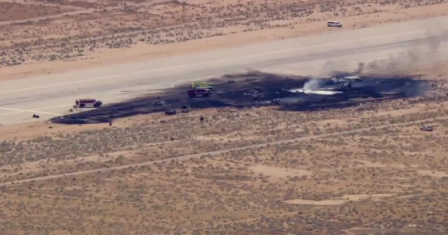
The bomber took off around 11:20 a.m. Monday on a test mission tied to the Air Force’s Radar Modernization Program, CBS News reported. It crashed on the runway shortly after takeoff and burst into flames. Aerial footage showed a large burn scar and a plume of smoke visible for miles; The Guardian reported that footage showed virtually nothing left of the aircraft.
Col. James Hayes, deputy commander of the 412th Test Wing, called the crash “unsurvivable,” despite immediate response efforts.
The team aboard the aircraft was operating as a Combined Test Force, an Edwards structure that brings together active-duty airmen, military contractors and government civilians for specific projects. Estrella was part of the Air Force Operational Test and Evaluation Center at Edwards. Dee and Hovey were pilots with the 419th Test Squadron. Davis was a weapons system officer, and Smith worked as a flight test engineer with the 419th Flight Test Squadron, according to CBS News. Rischar was a contractor and flight test engineer. Middleton was a Boeing pilot, and Watson was a Boeing weapons officer and Air Force reservist assigned to Naval Air Station Joint Reserve Base in Fort Worth, Texas.
Boeing said Watson and Middleton were company employees and that their loss “is deeply felt across our teams, and our hearts remain with their families, loved ones and those who worked with them.”
NBC News reported that Smith had become a father to his second child four months before the crash and had returned to work only a week earlier, according to his widow, Lauren Smith. “It is such a horrible hurt, and I’m still processing everything that happened,” she told Eyewitness News KBAK-CBS and Fox58. She said he died doing what he loved.
No cause has been determined. The Air Force Accident Investigation Board will examine the crash, and officials said initial conclusions could take up to six months. Aviation safety experts cited by The Guardian said early questions may focus on flight controls or engines, but stressed it is too soon to know; investigators are expected to consider factors including the aircraft’s age and maintenance.
The B-52 involved in the crash was part of an effort to keep the bomber flying for decades. The Radar Modernization Program is intended to upgrade B-52s so they can remain in service into at least 2050. The aircraft had arrived at Edwards in December after receiving a modernized radar at Boeing’s San Antonio facility, The Guardian reported, and was to be used as a testbed through 2026.
The B-52 entered service in 1955 and can carry conventional and nuclear weapons. CBS News reported that the U.S. military is spending nearly $50 billion to upgrade the fleet. Doug Birkey, executive director of the Mitchell Institute for Aerospace Studies, told CBS the planes have “tremendous” payload capacity and range, but said their age creates risk. “When you are dealing with aircraft of this age and when you are pressing for the high-performance type scenarios, we’re asking folks to take a lot of risk,” he said. “And clearly, eight people paid with their lives.”
The airfield remained closed after the crash, though other base operations resumed, according to The Guardian. CBS News reported that the airfield would remain closed until at least Thursday and that flight test operations were expected to resume early next week.
Edwards, about 100 miles from Los Angeles in the Mojave Desert, is home to the 412th Test Wing and conducts much of the Air Force’s aerospace testing. The base said supporting families and team members remains its primary objective and has opened an Emergency Family Assistance Center offering mental health services, childcare assistance, legal counsel and chaplain support.





Be First to Comment