Key takeaways:
- At least 68 people died and dozens were injured in Wednesday’s collision near Urda.
- Transport Minister Óscar Puente said a control center cleared the Renfe train to move without speed restrictions after a safety-system failure.
- The crash followed a January rail disaster near Córdoba that killed 46 people.
Spain began three days of mourning Thursday after a high-speed train struck another train from behind, killing at least 68 people and injuring dozens in the country’s second deadly rail disaster this year.
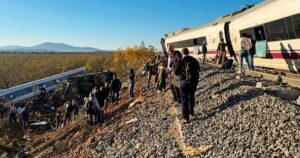
The collision happened Wednesday morning near Urda in the central province of Toledo. A train operated by the state-owned company Renfe hit a stationary train run by private operator Iryo, sending several carriages down an embankment. The BBC reported that the Renfe train carried 397 passengers and the Iryo train 147.
Emergency crews worked through the night under floodlights, cutting into damaged carriages to search for victims. Hundreds of personnel were deployed, and drones and helicopters helped locate victims and clear rubble, according to Spain’s interior ministry. Workers began using cranes to move parts of the trains late Wednesday, NPR reported.
Prime Minister Pedro Sánchez visited the crash site and pledged an investigation. The “whole of Spain is grieving,” he said, adding that “lives have been shattered, families have been torn apart, the pain is immense.”
Transport Minister Óscar Puente said a computer malfunction disabled a safety system along a 63-kilometer (39-mile) stretch of track at about 8:30 a.m., bringing trains to a halt. The Iryo train was stopped near Urda, while the Renfe train was about 25 kilometers (15.5 miles) behind it. A central control center then instructed the Renfe train to move without speed restrictions, despite an active stop signal, Puente said. The trains collided at 8:53 a.m.
Puente called the instruction “inexplicable” and said the train drivers were not to blame. NPR reported that he attributed the crash to human error at the control center. Officials are investigating the disaster.
Witnesses described passengers bleeding or trapped in their seats as smoke spread through the carriages; one carriage caught fire, the BBC reported. Many of the dead had yet to be identified. The Civil Guard established offices in Madrid, Toledo, Seville and Córdoba to handle missing-person reports. “The top priority is the identification of the missing persons and the taking of DNA samples to be able to locate their relatives,” it said on X.
The crash came four weeks before a national election and followed a January collision near Córdoba that killed 46 people. Both crashes involved Renfe and Iryo trains, according to NPR. Sánchez said it was “not acceptable” for Spain to suffer two high-speed rail disasters in one year and pledged to strengthen safety.
Most political parties suspended campaigning. Opposition leader Alberto Núñez Feijóo called for a full investigation, saying Spaniards were asking questions that “demand answers.” Far-right Vox continued campaigning; its leader, Santiago Abascal, said mourning should not be used to silence criticism of rail infrastructure, the BBC reported.
About 1,500 people gathered outside the Transport Ministry in Madrid overnight, according to Spanish broadcaster TVE. Police used tear gas after protesters threw bottles and flares; no injuries or arrests were reported. Rail drivers planned to proceed with a Thursday strike “in defence of railway safety,” their union said.


Be First to Comment