Key takeaways:
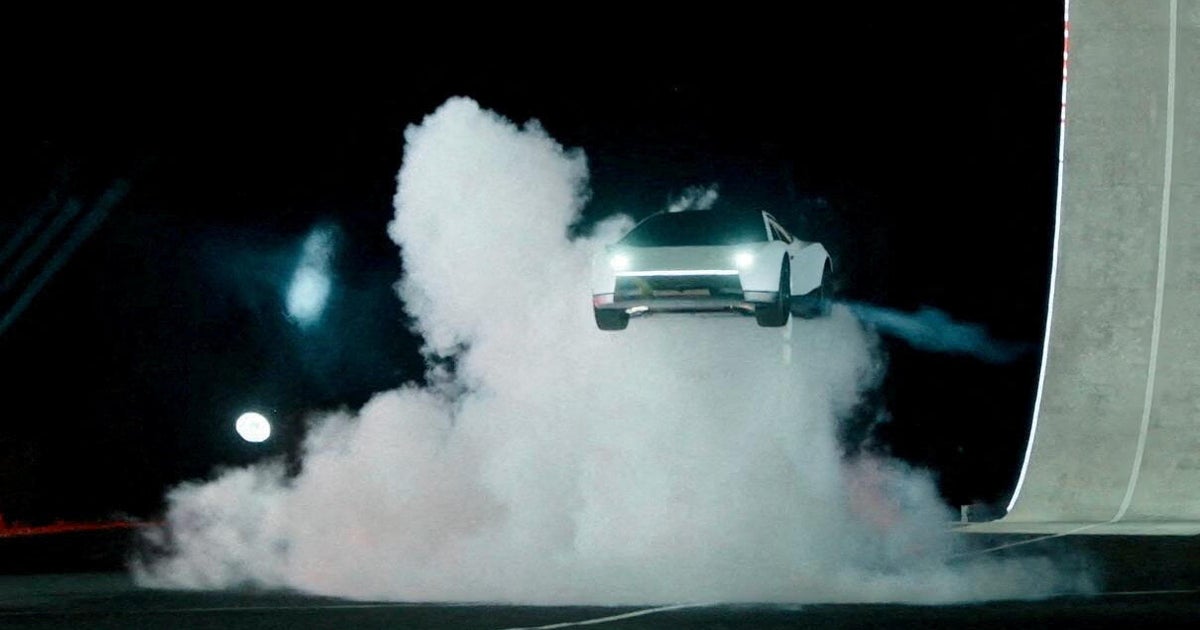
- The Roadster prototype launched from a curved ramp and landed on its wheels during a demonstration at a SpaceX facility in Texas.
- Musk said production would begin in 2028; the second-generation Roadster was first unveiled in 2017 with a 2020 production target.
- Tesla plans Performance, Thrust and invitation-only Rocket versions; the Rocket version is not approved for public roads.
Elon Musk unveiled a Tesla Roadster prototype that launched off a ramp, rolled in midair and landed on its wheels Thursday, showing how rocket-inspired thrusters could give the long-delayed sports car brief airborne capabilities. Production is planned for 2028, Musk said, eight years after the vehicle was originally expected to arrive.
The demonstration took place at a SpaceX testing facility in Texas and was livestreamed on Tesla’s X account. Musk, who leads both companies, told the audience the stunt would prove what they were about to see “was not AI or SI.” The car drove up a curved ramp, clung to its surface while upside down, then launched into the air. NBC News reported that it cleared five other Tesla vehicles before landing in a cloud of condensation.
“Well, it worked!” Musk said afterward. “Flying cars are real,” he said, while cautioning that the vehicle’s “success is not guaranteed” but “it will probably work.” He also said it was “not necessarily a safety-optimized car.”
Musk said “ultra high-pressure air tanks” propel the car into the air. Tesla says a fan-based suction system holds it against the road surface, while self-refilling cold-gas thrusters enable airborne maneuvers. In another run, the car jumped 27 feet and performed a barrel roll, according to Tesla, as reported by NBC News. Tesla also reported a zero-to-60-mph time of 0.81 seconds during the event.
Tesla plans three versions of the Roadster. According to NBC News, the base Performance model will have the suction system but no thrusters; a Thrust version will add rear-mounted thrusters for acceleration; and an invitation-only Rocket version will seat one person and carry the full system used in the demonstration. Tesla’s website says the Rocket version is not approved for public road use. Musk acknowledged that the Roadster’s airborne features might not be legal in every jurisdiction.
The second-generation Roadster was unveiled in 2017, when Musk initially promised production in 2020. The company has repeatedly delayed it. No price or release date was announced Thursday beyond the stated 2028 production target. Musk said he wants the car, when released, to reach about 383 mph and travel 300 miles on a charge, NBC News reported.
The outlets reported different reservation terms. CBS News said Tesla’s website listed a $5,000 deposit for a non-flying Roadster and did not allow reservations for the Thrust model. NBC News reported a $50,000 initial deposit for the base model and $250,000 for the Thrust version.
Wall Street analyst Dan Ives of Yorkville Ives said the Roadster was unlikely to contribute substantially to Tesla’s sales or revenue because production would probably be limited. Its significance, he said, was in showcasing engineering shared by Tesla and SpaceX.




Be First to Comment