Key takeaways:
- Iran says its seven-day reopening plan was conveyed to the United States through Qatar.
- A U.S. official says nearly 40 million barrels of oil passed through the strait over 48 hours.
- Pezeshkian says Iran would permit U.N. nuclear inspections, with arrangements to be settled in negotiations.
Iran says it can reopen the Strait of Hormuz within seven days if the United States accepts a new proposal, but President Masoud Pezeshkian warned that deep distrust could complicate talks over the waterway and Iran’s nuclear program.
Foreign Minister Abbas Araghchi said Friday that Iran had sent a “concrete seven-day plan” to Washington through Qatar after indirect talks on the sidelines of the United Nations General Assembly in New York. “If the necessary conditions are met, the strait can be reopened, and normal maritime passage restored within seven days,” he told reporters. “The choice now rests with the United States.”
The clock would start when Washington accepts the plan, Araghchi said. He said the required U.S. actions could be completed in four or five days and were already covered by commitments in a June memorandum of understanding on a temporary ceasefire. One condition, he said, is U.S. acceptance of a maritime transit route agreed upon by Iran and Oman.
A U.S. official told NBC News that the administration was holding positive, constructive discussions through mediators but was not rushing toward an agreement. “The United States is in a very strong position with control of the Strait of Hormuz, so we are not in a rush,” the official said, adding that nearly 40 million barrels of oil had passed through the strait over the previous 48 hours.
Washington has opposed Iranian control over routes into the strait, including routes through Omani territory, as well as tolls on passing ships, CBS News reported. Iran has demanded that vessels seek permission and follow an Iranian-approved route. The waterway carried about 20% of the world’s oil before the conflict, according to NBC News.
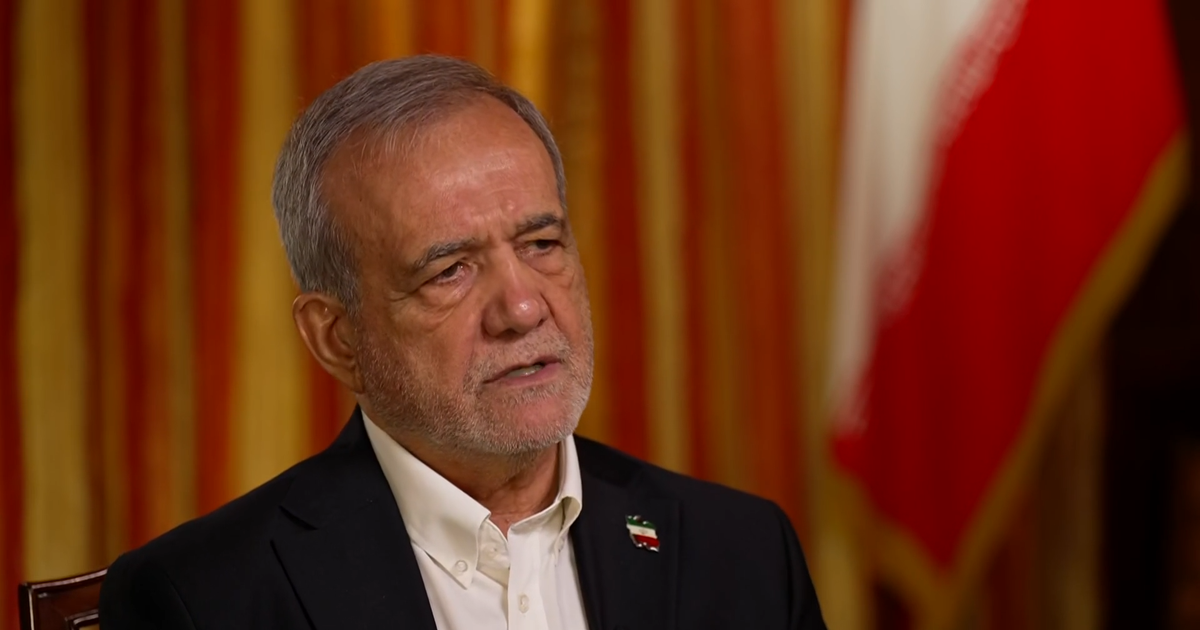
Pezeshkian told CBS News on Friday that Iran would “abide by whatever we commit to” if the United States accepted the proposal. Asked about meeting President Donald Trump in New York, he cited an “atmosphere of distrust” and questioned whether Washington would honor an agreement. “Every day, they increase the sanctions against us. Every day, they threaten us. Every day, they strike us,” he said.
Trump had expressed openness to a meeting, but none took place. He said at the General Assembly that he faced a “big decision” on whether to make a deal with Iran or “annihilate” it. Trump has predicted an agreement will come after November’s midterm elections; Pezeshkian told NBC News on Thursday, “We don’t want it to get to the midterm elections.”
The two governments also remain divided over Iran’s nuclear program. Iran has enriched uranium to near weapons-grade purity but denies seeking a nuclear weapon. Trump has said Iran must stop enriching uranium. Pezeshkian told CBS News that Iran would allow U.N. nuclear inspectors into the country, though he said arrangements for inspections could be agreed during negotiations. Asked twice whether inspectors would be admitted, he replied each time, “That is absolutely correct.”
The earlier ceasefire collapsed after renewed attacks. Pezeshkian blamed the United States, while CBS News reported that Iran had targeted commercial ships before U.S. strikes on Iran. The new proposal would reopen the strait and restart talks as an initial step toward a final nuclear deal.




Be First to Comment