Key takeaways:
- Trump and Xi are expected to discuss an AI safety mechanism during Xi’s first U.S. state visit since 2015.
- China is building hundreds of data centers in regions including Inner Mongolia, Ningxia, Gansu and Guizhou to support its goal of embedding AI across 90% of industries and society by 2030.
- A temporary U.S.-China trade truce involving tariffs and rare earth export restrictions is set to expire in November.
Donald Trump and Xi Jinping are set to put artificial intelligence at the center of their latest face-to-face talks, even as China races to build the data centers, talent pipeline and regulatory influence it says will shape the next phase of global technology.
Xi is due in Maryland on Wednesday for his first state visit to the United States since 2015 and his second in-person meeting with Trump this year. Their previous summit, in Beijing in May, produced pledges to build “strategic stability” but few concrete results, with the two countries still divided over trade, export controls and geopolitics.
“Expectations are very low,” Bonnie Glaser, managing director at the German Marshall Fund, told The Guardian. “Nobody is using the term ‘deliverables’.”
One possible area of agreement is AI safety. Scott Bessent, the U.S. treasury secretary, concluded talks Sunday with Chinese Vice-Premier He Lifeng by proposing an AI safety mechanism between Washington and Beijing, The Guardian reported. The mechanism appears to fall short of a major safety agreement.
The issue has gained urgency as both governments frame AI as a strategic contest. “We’re leading China in AI,” Trump said recently. “And frankly, I want to keep it that way, because whoever wins AI, wins.” Dario Amodei, chief executive of Anthropic, has called for maintaining the U.S.-led ban on selling advanced chips and equipment to China, warning that a Chinese lead would “pose grave danger for the US and the world.”
Beijing rejects that framing. The state-run Global Times dismissed U.S. fears as part of a “Cold War playbook” to “contain” China’s rise, the BBC reported. China’s foreign ministry said “fearmongering, confrontation and vicious competition will only disrupt the process of global AI governance,” according to The Guardian.
China has already moved to regulate parts of the sector, including mandatory labelling of AI-generated content, restrictions on children’s use of AI companions and limits on what chatbots can say. Xi has repeatedly called for more regulation and a global framework, while encouraging Chinese firms to build cheaper, open-source models that users, companies and countries can modify.
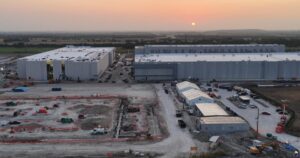
At the same time, China is expanding the physical infrastructure needed to power AI. In Ulanqab, Inner Mongolia, long known as China’s “potato capital,” fields now sit beside construction sites for vast data centers. “This is China speed,” one worker told the BBC, calling the country “an infrastructure maniac.” An electrical engineer said: “There is one phase every year. This is the second phase. There will be many more phases afterwards.”
The data centers are part of Beijing’s plan to embed AI across 90% of industries and society by 2030, the BBC reported. China is building hundreds of facilities for companies including Huawei, ByteDance and DeepSeek in sparsely populated areas such as Ulanqab, Ningxia, Gansu and Guizhou, where land is cheaper, weather is cooler and renewable energy capacity is large.
There are concerns. China wants most data centers to run on green energy by 2030, but parts of its grid still rely on coal. Water remains an issue in dry areas of Inner Mongolia. Some villages have been relocated, though the number of residents and compensation terms are unclear.
“This big data has absolutely nothing to do with ordinary people,” one local told the BBC anonymously. “What benefits has it brought us?” Others said few local people had found jobs, while some feared losing farmland.
China is also building its AI workforce. Jack Zhang of the University of Science and Technology of China said fewer students and researchers are going to the U.S., while more are returning to China. The BBC reported that China produces about five million science and technology graduates each year, compared with about half a million in the U.S.
Yet some academics see limits. “It’s not as open as I wish,” said Liu Jun, a professor at Tsinghua University who has taught at Harvard and Stanford. “I keep encouraging students here to ask more questions, to challenge more, but that’s hard to change. I think partly it’s culture, partly it’s the system.”
Beyond AI, trade will remain high on the summit agenda. A temporary truce struck last year, including a pause on tariffs and an agreement for Beijing to loosen rare earth export restrictions, expires in November. Taiwan, Iran and Ukraine also continue to divide the two governments, leaving analysts cautious about the prospects for a broader breakthrough.



Be First to Comment