Key takeaways:
- At least seven people were killed after storms beginning Aug. 11 brought flooding, tornadoes and damaging winds to northwestern Indiana and nearby states.
- More than 30,000 NIPSCO customers remained without electricity Saturday, down from 374,500 at the height of the outages.
- Indiana Gov. Mike Braun requested an expedited FEMA major disaster declaration for 54 counties and estimated losses could exceed $5 billion.
Thousands of northwestern Indiana residents entered another day without electricity Saturday after powerful storms battered the region, killed at least seven people and left communities struggling with heat, spoiled food, closed businesses and dark streets.
The storms began Aug. 11 and brought days of severe weather, including record rainfall that flooded several communities. In Gary, one of the hardest-hit cities, the storm knocked out power to more than half of residents. About one in three people in Gary lives in poverty, according to U.S. Census data.
“It’s been absolutely horrible,” Gary resident Shatiya Hardin told CBS News. “At night we’re sweating, we’re irritable, we have children to look out for, elderly people who need electricity for oxygen tanks.”
Northern Indiana Public Service Company, the region’s major electric utility, said Saturday that more than 30,000 customers remained without power. CBS News reported just over 30,100 NIPSCO customers were still affected, while The Guardian reported the utility’s figure as 33,124. At the height of the storms, 374,500 customers had lost electricity, and NIPSCO said it had restored service to 341,376 customers.
The company said “substantial progress has been made in restoring service to our communities,” while warning customers they “may continue to encounter circumstances that temporarily increase numbers of outages.” Gary residents have been told some service may not be restored until Tuesday, two weeks after the storms began, The Guardian reported.
For many residents, the outage has reshaped daily life. Food lines have formed, schools and businesses have closed, phones have died, gas pumps have gone dry, and people have dealt with spoiled food and laundry piling up. Many in Gary have relied on a community center for hot meals, air conditioning and a place to charge phones.
“It’s not OK for us to continually be in survival mode,” Hardin said. “We don’t have service in this area at all whatsoever. At night, the streets, the roads, everything is pitch black besides the lights from the cars.”
Other residents described similar conditions. Cynthia Hunter of Gary told a CBS affiliate that her family had been charging electronics in a vehicle and had spent nights in a truck “just for air.” Renita Theus, 41, told The New York Times, according to The Guardian, “Every day I’m crying. It’s hot in the house. I toss and turn and can’t sleep.” She added, “I feel bad for newborn babies and people on ventilators. I think if this was a richer area, it would be different.”
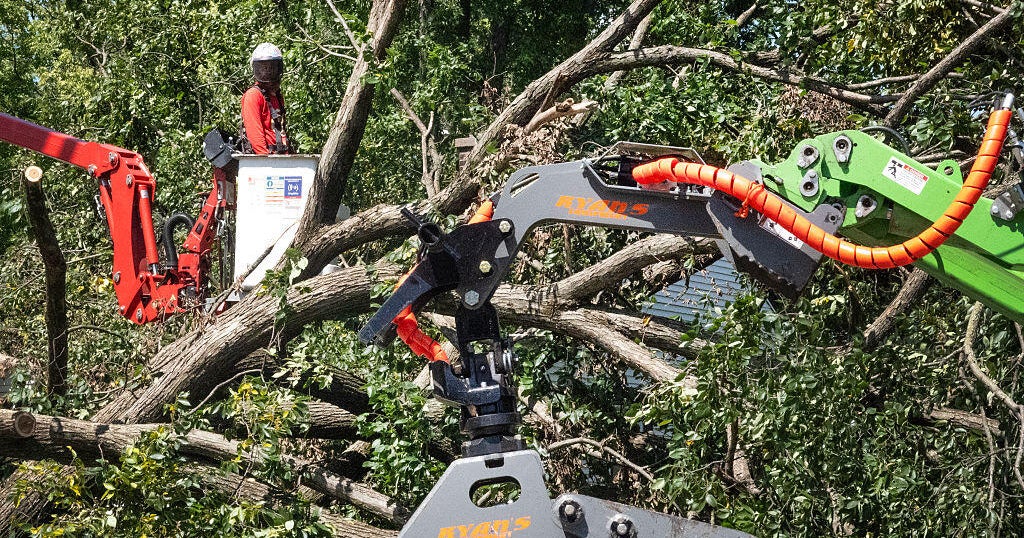
The storms damaged about 300 power poles and left downed trees and debris across neighborhoods, including Gary’s Aetna neighborhood. The broader system affected Indiana, Ohio, Illinois and Kentucky, bringing winds of more than 80 mph, severe flooding and tornadoes. The National Weather Service’s Storm Prediction Center recorded straight-line winds of 99 mph in Gary, The Guardian reported.
Indiana Gov. Mike Braun on Thursday requested an expedited major disaster declaration from FEMA for 54 counties, seeking individual and public assistance. Braun said losses from the storm and its aftermath could exceed $5 billion. His request said the system produced at least three confirmed tornadoes, flash flooding and extreme straight-line winds, with rainfall of 6 to 9 inches in many areas and a high report of at least 11.23 inches.
“If granted, this declaration will mean significantly more resources to accelerate Indiana’s recovery from the recent severe weather,” Braun wrote on social media. The Guardian reported that the Trump administration granted an emergency declaration for affected Indiana counties and that a state relief fund is providing emergency aid grants of up to $5,000.
Residents this week filed a proposed class-action lawsuit against NIPSCO, accusing the utility of failing to trim trees and vegetation that they say brought down power lines. “This situation was predictable. It was obvious and it was preventable,” attorney Otto Shragal of the Allen Law Group said, according to The Guardian.
NIPSCO rejected the allegations. “We strongly disagree with the characterization of NIPSCO’s vegetation management practices,” the company said, adding that its “vegetation management spend has more than doubled since 2016.” The utility also said it was suspending disconnections for customers struggling to pay bills.
Gary Mayor Eddie Milton told CBS News the city would review its emergency management response. “But going back to the utility side,” he said, “what I’m going to encourage and demand is that we start having more accountability.”










Be First to Comment