Key takeaways:
- Jury selection in Luigi Mangione’s state murder trial is expected to begin Sept. 8 in Manhattan.
- Justice Gregory Carro said jurors will remain anonymous and an overflow courtroom will be available if the main courtroom reaches capacity.
- Mangione has pleaded not guilty to state murder, weapons and forgery charges and also faces federal stalking charges.
A New York judge said Tuesday that jurors will remain anonymous in Luigi Mangione’s murder trial over the killing of UnitedHealthcare CEO Brian Thompson, while also arranging an overflow courtroom for a case that has drawn intense public and media attention.
New York state Justice Gregory Carro announced the decisions at a final pretrial conference in Manhattan state court ahead of jury selection, which is expected to begin Sept. 8. Carro did not explain why the jury’s identities would be withheld from the public. Anonymous juries are relatively unusual in U.S. criminal trials, though judges sometimes use them in high-profile cases when there are concerns about harassment or intimidation.
Mangione, 28, is accused of fatally shooting Thompson outside a Midtown Manhattan hotel on Dec. 4, 2024, as Thompson headed to an investor conference. He has pleaded not guilty to state murder, weapons and forgery charges. He was arrested several days after the killing at a McDonald’s in Pennsylvania.
The hearing also addressed a dispute over public access to the trial. Carro said an overflow courtroom would be available to journalists and members of the public if the main courtroom reaches capacity. The initial media access plan had not included one, drawing criticism from journalists and press access advocates.
“There has never been a discussion or a decision by this court to exclude or limit public or the press in these proceedings,” Carro said. “Quite the opposite is true.”
Carro rejected suggestions from Mangione’s defense team that prosecutors or court officials had acted improperly in developing the media plan. “At no time did the district attorney’s office participate in those discussions nor did it play any role in determining media or public access,” he said, calling any contrary notion “incorrect.”
He said claims of exclusion, secrecy or impropriety were “without merit and reflect a reckless mischaracterization of the efforts undertaken by this court to ensure transparency and public access.” He added: “So, I don’t want to hear any more about this.”
Marc Agnifilo, one of Mangione’s lawyers, thanked the court for adding the overflow room and said, “Our objections seem to have resulted in a change.” Carro responded: “It had nothing to do with your objections. It’s always been under consideration. They had to find a physical place and it has to be staffed, so that’s why it took long to figure it out.”
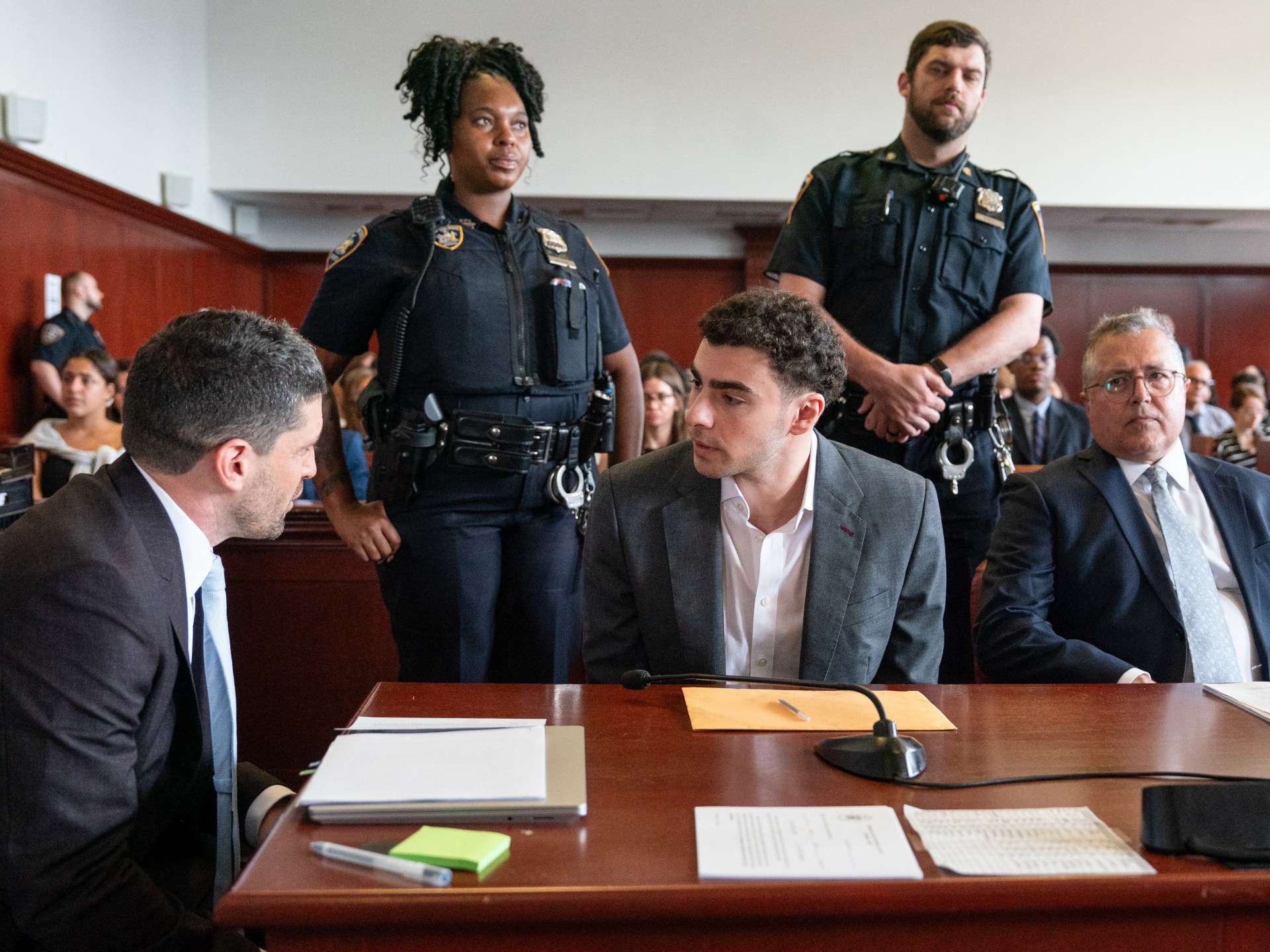
Mangione appeared in court Tuesday morning in handcuffs, wearing a slate-colored suit and white shirt. The courtroom was nearly full, with almost two dozen apparent supporters present. Some wore bright green wristbands, and one woman wore a black T-shirt reading “OPEN THE COURTROOM.”
The case has drawn international attention after Thompson’s killing reignited debate over the U.S. for-profit healthcare system and private insurers. Al Jazeera reported that police have said the words “delay,” “deny” and “depose” were written on ammunition connected to the shooting, echoing a phrase used by critics of insurance companies.
Prosecutors say their evidence includes hundreds of hours of surveillance footage, fingerprints, DNA, a mobile phone and a gun they say matches ballistics from the killing. Al Jazeera reported that Carro ruled last month that a 3D-printed pistol and a notebook allegedly belonging to Mangione could be admitted at trial. Prosecutors say the notebook contains writings about targeting a health insurance executive and rebelling against what it calls the “deadly, greed fueled health insurance cartel.”
Mangione also faces federal charges stemming from Thompson’s killing. He has pleaded not guilty in that case. Al Jazeera reported that federal murder and weapons charges were thrown out last January on legal grounds, removing the possibility of the death penalty, but that federal stalking charges remain and could carry a life sentence if he is convicted. His federal trial is scheduled to begin in January.








Be First to Comment