Key takeaways:
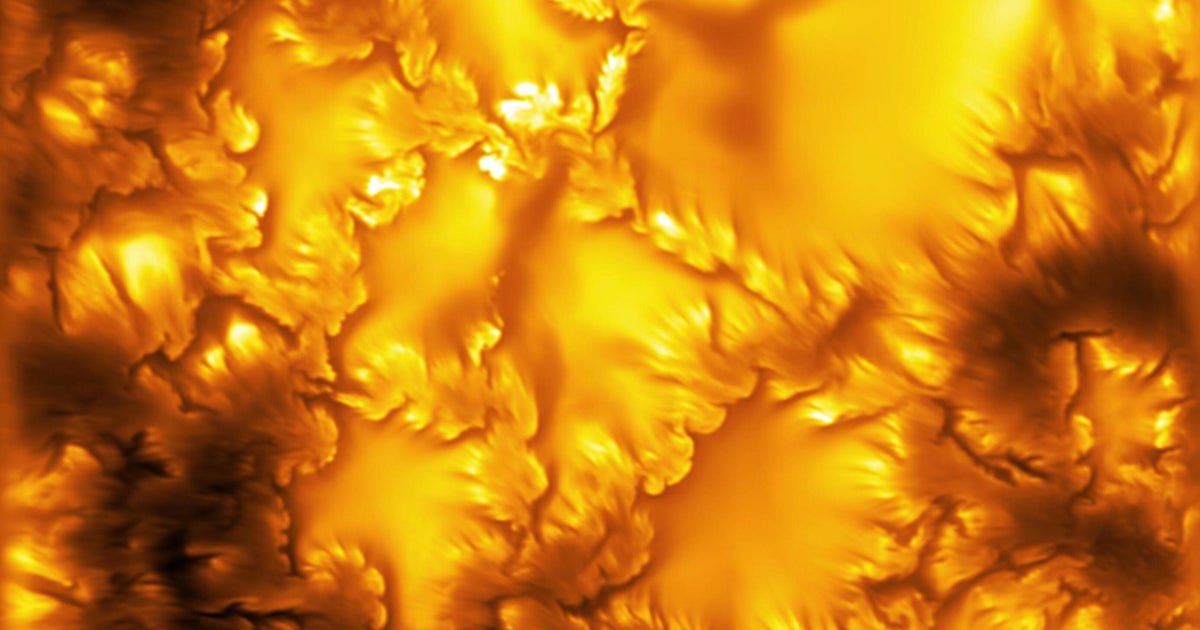
- The Inouye Solar Telescope captured the sun’s surface in the highest resolution yet, revealing small swirling features at the edges of magnetic regions.
- Researchers identified the features as Kelvin-Helmholtz instability, a fluid-dynamics phenomenon not previously observed at this level on the solar surface.
- Scientists say the findings could improve understanding of solar flares, coronal mass ejections and space weather that can disrupt satellites, power grids and GPS communications.
Scientists using the world’s most powerful solar telescope have captured the sun’s surface in the sharpest detail yet, revealing whirlpool-like patterns that could help explain how the star generates space weather that affects Earth.
The images and footage, made with the National Science Foundation’s Daniel K. Inouye Solar Telescope on Maui in Hawaii, show small, dynamic swirls at the edges of magnetic regions on the sun’s bright outer shell. Researchers initially took the images to fine-tune the telescope and test its limits, CBS News reported, but the results revealed solar features at higher resolution than ever before.
The National Solar Observatory said the images “reveal a solar landscape unlike any that had been seen before, uncovering small-scale and dynamic swirls everywhere at the edges of magnetic areas.”
Scientists identified the patterns as Kelvin-Helmholtz instability, a phenomenon that occurs when fluids move past each other at different speeds and small disturbances grow into spiraling vortices. On Earth, the same process can help explain how wind creates waves on water. It has also been seen on planets including Jupiter and Saturn, but not previously at this level on the solar surface, according to study co-author Friedrich Wöger of the National Solar Observatory.
The findings were published in the journal Nature.
In the sun’s case, the motion involves hot, magnetized plasma. “These twisting motions are creating magnetic energy, which can build up to produce those large-scale explosions,” National Solar Observatory astronomer Dr. David Kuridze told the BBC.
Those explosions include solar flares and coronal mass ejections, bursts of energy and material that can travel toward Earth. When they hit, they can trigger solar storms, disrupt satellites and power grids, scramble GPS communications, produce colorful auroras and potentially injure astronauts, according to the BBC and CBS News.
“The Sun is the source of that energy and of all of that space weather,” Dr. David Boboltz of the National Solar Observatory told the BBC. “To figure out and eventually predict space weather, we want to understand the physics of the Sun, all the way down to the smallest scales.”
Wöger told the BBC that detecting Kelvin-Helmholtz instability on the sun’s surface helps explain not only the dynamics behind space weather, but also how energy is transported upward and why the solar surface is so hot. “Once there’s enough energy wound up in the higher layers, it can then be released, as a flare or what’s known as a coronal mass ejection,” he said.
Boboltz, deputy director at the National Solar Observatory, called the discovery, “backed up by analysis of numerical simulations,” a “major step forward in our understanding of the dynamics and evolution of solar and stellar plasma, and will serve as a basis for future discoveries.”
The Inouye Solar Telescope uses a four-meter mirror, advanced optics and instruments from a high-altitude site in Hawaii, where the BBC reported clear skies are free of dust. Dr. Jacqueline Keane, NSF program director for the National Solar Observatory, said the telescope’s resolving power made the new observations possible.
“To understand the dynamic space weather that affects Earth, we have to see the small-scale processes driving it,” Keane said. “For decades, seeing these vortices at such tiny scales remained elusive.”
Solar physicist Ruizhu Chen of Stanford University, who was not involved in the research, compared the patterns to art. “That reminds me of famous paintings, like the swirling skies in Van Gogh’s Starry Night,” Chen told CBS News.




Be First to Comment