Key takeaways:
- The Falcon 9 upper stage is expected to strike the moon at about 2:35 a.m. Eastern time Wednesday while traveling roughly 5,400 mph.
- NASA said the booster poses no danger to Earth and plans to observe the impact site with the Lunar Reconnaissance Orbiter.
- Scientists expect the crash to create a crater roughly 65 to 100 feet wide and may study the resulting dust plume for clues about material beneath the lunar surface.
A drifting SpaceX rocket booster is expected to slam into the moon early Wednesday, turning a piece of space hardware into an accidental lunar impact experiment watched by scientists on Earth and in orbit.
The 8,800-pound upper stage of a Falcon 9 rocket is predicted to hit the lunar surface at about 2:35 a.m. Eastern time, or 06:35 GMT, while traveling about 5,400 mph, NASA’s Centre for Near-Earth Object Studies said. NASA said there is no threat to Earth.
“There is no danger to Earth,” NASA spokesperson Jimi Russell told the BBC. “Nasa will continue to track the booster for training purposes, as well as later observe the impact site for scientific purposes.”
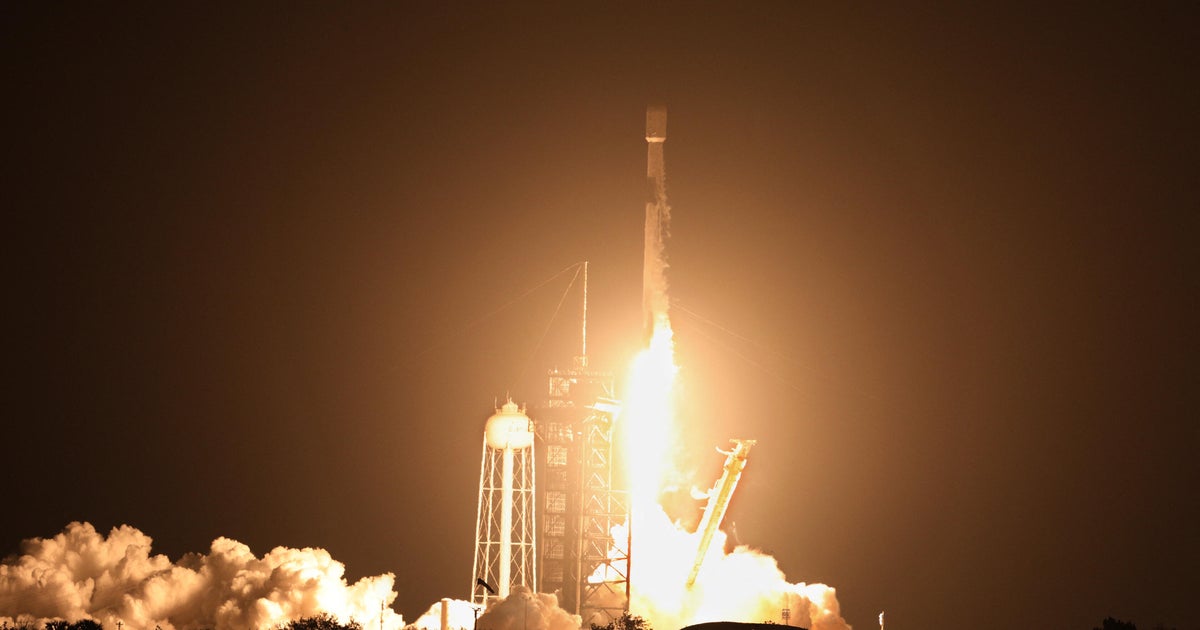
The rocket launched Jan. 15, 2025, carrying two lunar landers and scientific equipment as part of a U.S. and Japanese mission. Firefly’s Blue Ghost-1 successfully landed on the moon, while Japan’s ispace Hakuto-R crash-landed, CBS News reported. After releasing the spacecraft, the Falcon 9 upper stage remained in space.
Julianna Scheiman, SpaceX’s director of NASA Science and Dragon Programs, said Monday that the company followed “the appropriate rules and regulations” for disposing of the second stage after launch, but “what has happened is essentially a mixture of solar activity and gravity forces have put it on a path towards the moon.”
The booster is about 45 feet long and 12 feet wide — roughly the size of a five-storey building — and weighs at least 4,000 kilograms, or 8,800 pounds, on Earth. Astronomer Bill Gray, who first identified the trajectory, told the BBC it is expected to strike near the Einstein Crater, on the moon’s daylight side facing Earth.
The crash will not be visible to the naked eye. A study by nearly two dozen scientists said even observers using very large telescopes may struggle to see it because the impact will occur on the lit side of the moon. Researchers said no natural or artificial impact flash has ever been observed on the moon’s daylight side.
NASA confirmed that its Lunar Reconnaissance Orbiter will take before-and-after images of the impact site, though the photos likely will not be available for a week or two. The BBC reported that South Korea’s Danuri probe, large telescopes in the Americas and a citizen-science project involving amateur observers are also expected to help track the impact, plume and new crater.
“As a scientist, I also am very excited to see the observation,” Scheiman told reporters.
The collision is expected to release energy equivalent to 2.8 tons of TNT, according to the study cited by CBS News. It could leave a crater 65 to 100 feet wide and about 16 feet deep. Gray predicted a crater more than 17 meters, or 56 feet, across.
Dr. Matt Bothwell, public astronomer at the University of Cambridge, told the BBC the impact could throw up a large dust plume. “It’s something really huge smashing into the Moon. It’s not remotely dangerous, we can just watch the show,” he said.
Scientists hope the plume and exposed material will help them better understand lunar impacts and what lies beneath the surface. Carl Schmidt, a planetary scientist at Boston University’s Center for Space Physics, told CBS News he hopes the data may show how much water ice was hidden below that part of the moon.
“Just about everyone who can point a telescope at this object is going to,” Schmidt said.
Artificial impacts on the moon are uncommon, though they have occurred before. The first man-made object struck the moon in 1959 in an intentional Soviet collision. U.S. spacecraft parts hit during the Apollo era, and Japanese and European spacecraft later struck the surface. NASA intentionally crashed a rocket stage into a shadowed crater near the lunar south pole in 2009, confirming the presence of water ice there. The BBC reported that the last dead rocket to hit the moon was a Chinese Long March 3C upper stage in 2022.













Be First to Comment