Key takeaways:
- Two Bell firefighting helicopters collided over Psatha west of Athens, killing one Greek and one Danish crew member; one Greek and one British crew member survived.
- Nearly 500 firefighters and 23 aircraft have been deployed against the western Attica wildfire, which has forced sea evacuations and threatened communities including Porto Germeno.
- Wildfires in Greece, France and Spain are part of a wider European crisis linked in the sources to extreme heat, drought and climate change-exacerbated fire conditions.
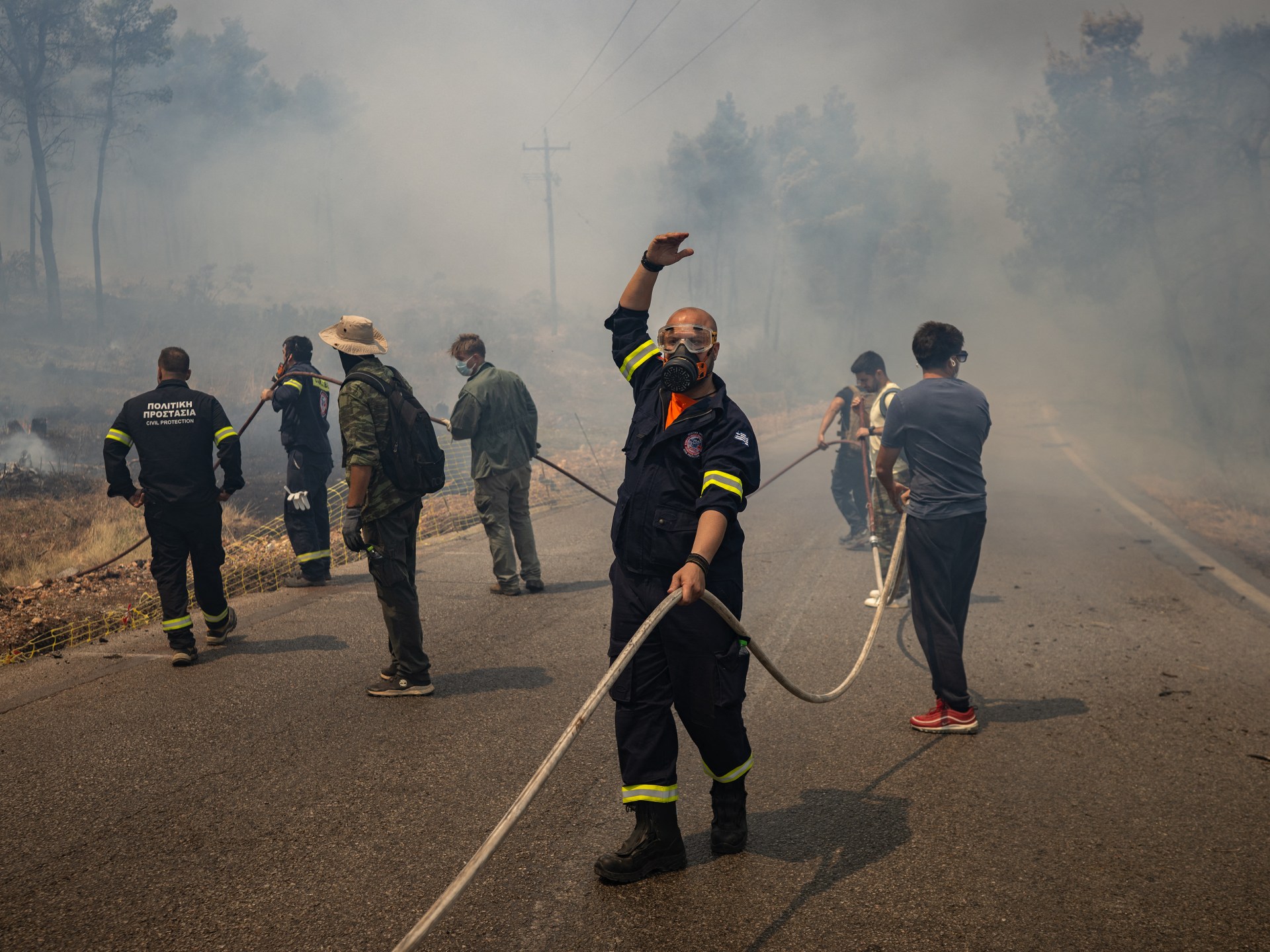
Two firefighting helicopters collided in midair west of Athens on Sunday while crews were battling a wind-driven wildfire, killing two crew members and sending one aircraft crashing to the ground in flames, Greek authorities said.
The Bell helicopters were operating over the Psatha area with two people aboard each aircraft. The dead were identified as one Greek national and one Danish national, while one Greek crew member and one British crew member were recovered alive. Al Jazeera reported, citing the Greek fire service, that both crew members from one helicopter died and the second crew was rescued. Television footage showed one helicopter explode and plunge after an apparent rotor collision.
The crash underscored the risks facing emergency crews as wildfires burn across Greece and other parts of Europe during a summer marked by record heat and little rain. The fire west of Athens began Friday near Agios Vasileios before sweeping toward Porto Germeno and into forested mountains. Strong winds pushed flames deeper into western Attica, the region that includes Athens, threatening communities and an industrial district.
Authorities ordered evacuations in Kandili, Agia Skepi and Toutouli, while firefighters remained especially concerned about Porto Germeno, a seaside community on the Gulf of Corinth. Crews evacuated 254 people by sea Friday and another 12 Saturday after smoke and fire cut off roads from coastal areas. Prime Minister Kyriakos Mitsotakis was briefed on the firefighting operation.
Nearly 500 firefighters and 23 aircraft have been deployed to the western Attica fire, though gale-force winds hampered the response and at times prevented aircraft from reaching the sea to collect water. Al Jazeera reported that reinforcements were also arriving from France and Romania.
Separately, firefighters were battling a blaze around Porto Germeno where flames crossed a mountain and reached a military firing range, activating unexploded ammunition, Al Jazeera reported. The Greek daily Protothema reported that more than 10,000 hectares, or 24,200 acres, had likely been destroyed and that crews were trying to keep the fire from reaching the coastal town of Megara after flames reached the settlement of Veniza.
“The fire has been burning since last night; it is certain that they cannot have forces everywhere. We as residents are doing everything we can,” said Tasos Tzempelikos, 61, who was pouring water on the fire with his son in Agios Konstantinos.
Other fires were burning in Greece as well. On Kefalonia, flames threatened homes and forced evacuations from inland communities while aircraft dropped water over the Ionian island. Al Jazeera reported that a 44-year-old man was arrested Sunday on suspicion of deliberately starting a fire that broke out late Saturday in the Pastra area of southern Kefalonia, citing Greece’s ANA news agency. Firefighters also battled a blaze near Nea Tenedos in Halkidiki.
Earlier in the week, two firefighters died fighting a fire on Crete and a third was killed in the Peloponnese. “A pristine forest, a paradise, was surrendered to the hands of the fire,” local farmer Minas Tzortzanis said Saturday. “There are no words to explain what has happened. Destruction. Total destruction.”
Wildfires in France and Spain have also forced evacuations, though some blazes showed signs of easing over the weekend. In central Spain, fires were mostly under control, while about 800 evacuated residents in Caceres were allowed to return Sunday but remained confined to their homes as the fire stayed active. In France, fires in the Gironde and Var departments showed only minor flare-ups.
The fire emergency comes as Europe faces extreme heat and drought. Hungary’s only nuclear power plant was forced to shut for the first time in four decades as the Danube River fell to a record low, Al Jazeera reported. In Serbia, low Danube levels have sharply reduced output at major hydroelectric plants.
Europe entered 2026 after its worst fire year on record, with more than 3,860 square miles burned in 2025. The European Environment Agency has linked wildfires to nearly 800 deaths across much of Europe over four decades. The European Union’s Copernicus Climate Change Service says Europe has warmed more than twice the global average since the 1980s, and World Weather Attribution found that human-caused climate change made the extreme fire-weather conditions behind this year’s French blazes at least twice as likely.






Be First to Comment