
Key takeaways:
- Viktor Orbán concedes defeat after 16 years as Hungary’s prime minister.
- Peter Magyar’s center-right Tisza Party is projected to win 135 of 199 parliamentary seats.
- European leaders praise Hungary’s election as a move toward European Union values and democracy.
Hungarian Prime Minister Viktor Orbán conceded defeat Sunday night in a parliamentary election that ended his 16-year tenure. Opposition leader Peter Magyar’s center-right Tisza Party is projected to win a large majority, securing 135 out of 199 seats, enough for a supermajority, according to Hungary’s National Election Office with roughly 45% of ballots counted. Magyar’s party had more than 53% support compared to 38% for Orbán’s Fidesz party with 77% of votes tallied.
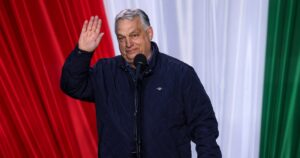
Orbán, the longest-serving leader in the European Union and a close ally of former U.S. President Donald Trump, described the election result as “clear” and “painful”. Speaking to supporters in Budapest, he said, “The responsibility and possibility of governing was not given to us. I congratulated the victorious party. We are going to serve the Hungarian nation and our homeland from opposition as well.” Magyar confirmed on Facebook that Orbán had congratulated him in a phone call.
Magyar, a moderate conservative, framed the election as a referendum on Hungary’s future direction. He told reporters the vote was “a choice between East or West, propaganda or honest public discourse, corruption or clean public life.” Addressing his supporters, Magyar said up to 6 million Hungarians had voted in a country of just over 9 million people. Despite thousands of reports of election tampering, he expressed cautious optimism about the victory.
The election marked a significant shift in Hungary’s political landscape. Orbán’s government has faced criticism from European Union officials and independent watchdogs for undermining democratic institutions, the judiciary, and media independence. Transparency International has ranked Hungary as the most corrupt country in the EU during Orbán’s rule. Orbán’s tenure was also noted for his pro-Russia stance and opposition to EU sanctions on Moscow amid the war in Ukraine.
European leaders reacted swiftly to the election outcome. European Commission President Ursula von der Leyen wrote on X, “Europe’s heart is beating stronger in Hungary tonight. Hungary has chosen Europe. Europe has always chosen Hungary. Together, we are stronger.” German Chancellor Friedrich Merz offered “heartfelt congratulations” and expressed eagerness to work with Magyar for a “strong, secure and, above all, united Europe.” French President Emmanuel Macron called the result “a victory for democratic turnout” and “Hungary in Europe,” while Spanish Prime Minister Pedro Sanchez hailed it as a win for “European values.” British Prime Minister Keir Starmer described the election as a “historic moment” for European democracy.
The campaign was marked by intense political conflict, including allegations of false flag operations, wiretapping, and a purported sex tape plot. Orbán’s campaign focused heavily on the war in Ukraine, frequently criticizing Ukrainian President Volodymyr Zelenskyy and accusing Ukraine of sabotaging a key oil pipeline. Hungarian authorities also seized a shipment of cash from a Ukrainian bank during the campaign period.
Orbán, 62, had cast his vote earlier Sunday, calling the campaign “a great national moment on our side” and stating, “I’m here to win.” Despite efforts including support from U.S. Vice President JD Vance, who campaigned alongside Orbán in Budapest, the election results signal the end of Orbán’s era in Hungarian politics.



Be First to Comment